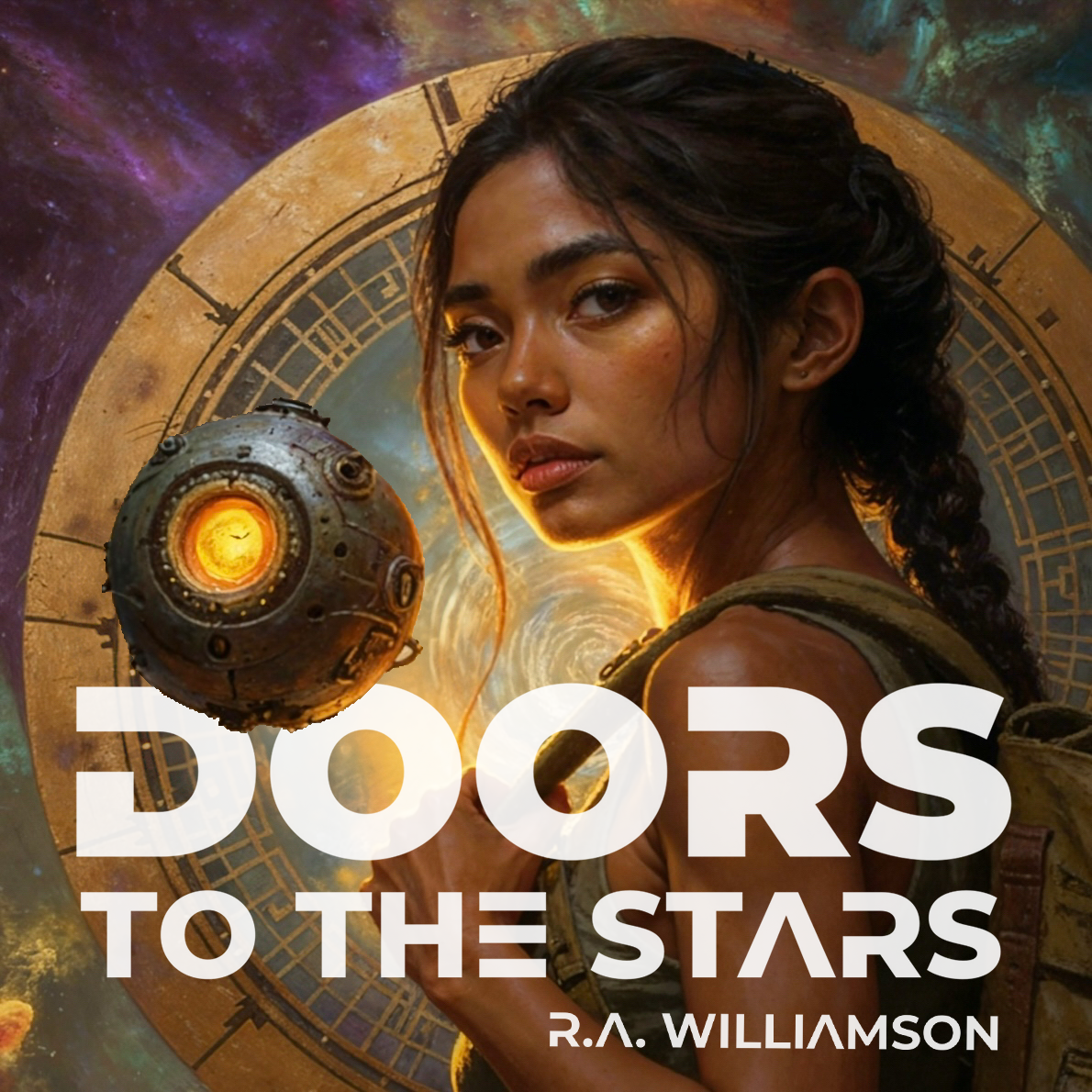
Doors to the Stars Sample Chapter
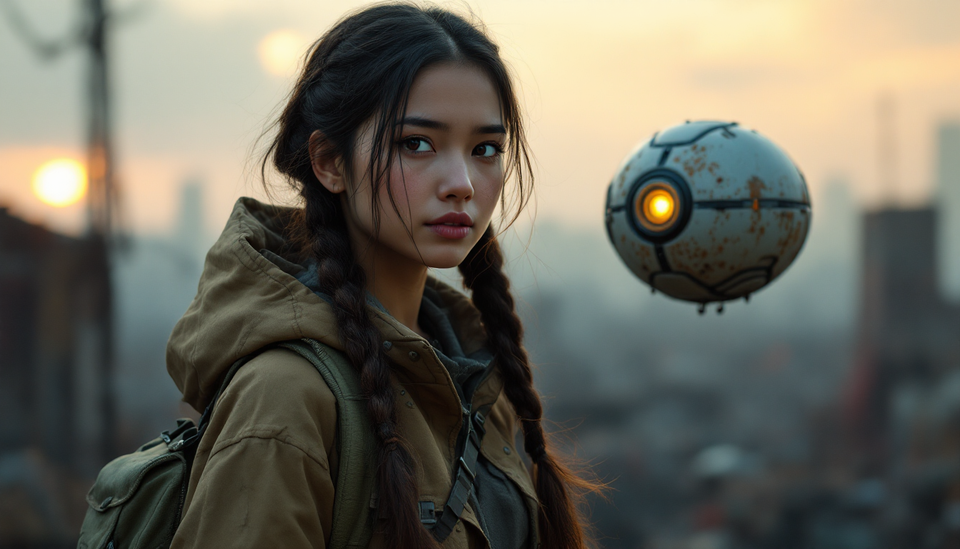
Doors to the Stars is a YA Space Opera about choosing what you’ll lose to save worlds that never gave a damn about you. For readers who loved Ship Breaker’s survival grit with Becky Chambers’s found-family heart, and protagonists who break—but keep going anyway.
Chapter One: Ashes to Ashes, Dust to Dust
The old city was dead long before the seawall broke and flooded everything two stories deep, but that’s when the last squatters finally abandoned the ruins. Now the bombed out towers sag and lean like drunken spacers, strangled in rust-colored vines. Sometimes they just come down. Two of my kids were in one when it fell last week, scavenging what had already been scavenged a hundred times over since the War. I warned them not to go, but I’m not exactly in charge, just responsible.
I never asked to be, but Cassandra’s sick and there’s no one else. Eli certainly isn’t going to step up. Ryn’s trying, but the other kids don’t respect her yet.
So there’s just me.
I swore to Kiva I'd never come back here, but Cassandra’s sick, so here I am.
There are hidden paths through the waterways, if you know what to look for, but why would you? No one comes down here anymore. Not unless you’re crazy.
Or desperate.
And I’m not crazy.
If I can’t find something to power the heater I don’t think she’ll make it through another night. Winter came too fast, and the cough she was always shrugging off got worse, and now it sounds like her lungs are full of gravel.
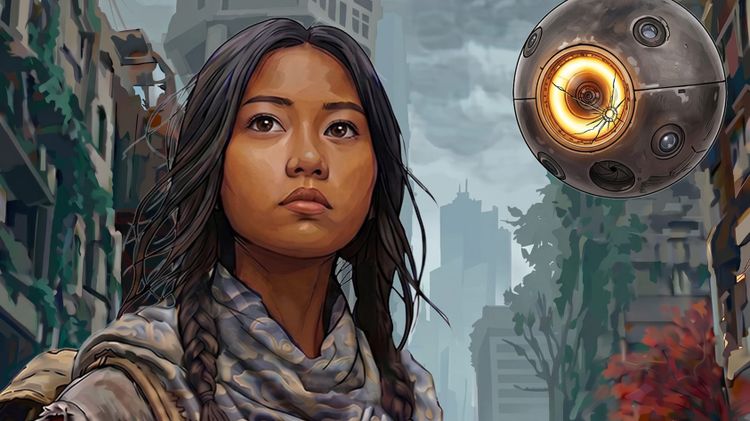
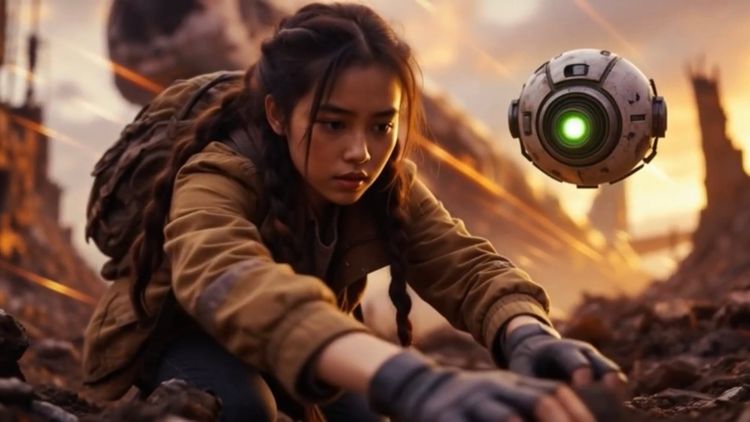
Plucking at the knotted cord around my wrist, I turn to the battered metal orb hovering over my shoulder, and I see myself reflected in his single cracked ocular sensor. My face is already a washed-out tan instead of this summer’s dark copper, and I didn’t realize the bags under my eyes were that bad. I look old. I am old. Old for a junk rat anyway. Kael calls me the Old Lady.
Grendel would laugh, but he’s two-hundred and twenty-seven. Or nine. Maybe forty. He lost count.
So have I.
Now I just mark each winter I survive. Six since my parents died. Two since I lost my brother to sepsis. He was six... I think. I was fourteen, maybe. I’m not sure. The long hungry months after we lost mama and papa were kind of a blur. Might have missed a birthday in there somewhere.
Gus—that’s what my brother named the rusted out old bauble floating beside me—turns his gaze to the old crashed rebel frigate in the distance, then back to me and flashes a quick amber pulse.
“Yeah, that’s the plan.” I sigh and shrug. “Figure it’s the only thing out here hasn’t been picked clean.”
He pulses a slow sequence in white.
“Right, because no one’s stupid enough to risk getting the Gys.” Hitching my ruck up by the straps, I start picking my way down through the islets of rubble. The stagnant, algae-choked water hides a lot of sinkholes. Deep ones. And everything here smells of rust and rot in a way that invades your nostrils and won’t let go. Smells worse in the summer though, so for once I’m glad it’s cold.
Doesn’t smell near as bad as the open sewer Arjuna and I lived next to before he died, but even that you get used to after a while.
It’s all relative I guess.
Gus and I pass a faded and peeling billboard of a male human raising his fist to the heavens with the slogan The Stars Belong to the Strong: The Ascendancy Shields Your Future! Someone spray-painted a devilish twirling mustache and goatee on his stern face in neon orange, and I can’t help but laugh as I work my way past it.
Here on Miller’s World you’re either working for the Ascendancy or under its boot. Same with most of the galaxy I suppose. Revolutions are always popping up, but they’re crushed in short order, until the next one comes along. Most of the freedom fighters I’ve met are no better than the Slagjacks, really. They just have catchier slogans. Me, I’m no revolutionary. I’m just trying to keep Cassandra’s crew alive through another winter.
Our crew, I mean. She’d say it’s ours.
The frigate—or maybe it’s a corvette, I don’t know warships—looms closer as we approach. It came down maybe fifty years ago, shot out of low orbit by the Ascendancy. Vines have already run up its sides, like they’re tying it to the ground so it can’t take off again. Looking at the way the spine’s broken, it’s not going anywhere, ever. They say it was part of one of the biggest rebel flotillas in a hundred years. A big united revolutionary effort. People still sing songs about the space battle over Miller’s World. Some aren’t even half bad, I guess, if you’re drunk enough.
We stop a short distance from the ship, and I put my hands on my hips and chew my lip, scanning the surface of the hull. Then I point. “See that door, about six meters up near the front? Looks like it’s blasted open enough to get inside.”
Gus gives me a white flash.
“Sorry, that airlock near the bow,” I sigh. Gus can be a little… what was Kael’s word? Pedantic. He’s old and glitchy and served in the Concord Navy during the War. Gus was a recon drone, technically, Kael said. I asked him once why the Corcord would program a drone to be a rude, sarcastic, pedantic ass, and he said that’s probably just a side effect of laying buried in a scrap heap for three hundred years before I found him and got him working with a lot of profanity and some spare parts.
The whole point was to sell the oversized ball bearing, and Kael was offering good cred too, but Arjuna adopted him, or Gus adopted my brother—either way they were inseparable, and… long story short, he’s family now. Only family I have left. So I’m stuck with him.
Gus says he sees the airlock by the bow.
“So?” I prompt. “Why don’t you go and see how hot it is in there. It’s been fifty years. Can’t imagine the radiation is too bad now. And there has to be something good in there we can trade for a power cell, right?”
He considers, like he’s tapping his lips, except he doesn’t have any, and then replies in serious amber and blue.
I just stare at him and quirk an eyebrow. “Really, Gus? Ghosts? No, I don’t care what Grendel says. Wrecks aren’t haunted, you big baby. Would Captain Glover be afraid of ghosts? Right. Didn’t think so.”
That seems to do the trick, and he gives a jaunty bob before flitting out toward the wreck. I hike up my ruck and trudge after him.
The hull is pitted and scored in a hundred places, so the climb up to the airlock doesn’t look too bad. Six meters is a long way to fall, but I’m a good climber. I’ve climbed worse. I’d be a better climber if I wasn’t so… Eli says I’m built like a scrumball. Dense, Cassandra said once. Sturdy. The opposite of her. But she’s Vylaraian, so I guess that goes without saying, doesn’t it. She meant it as a compliment, so I didn’t hold it against her.
Several minutes later I’m inspecting the split ends in one of my braids when Gus emerges from the airlock and flashes down at me in amber.
“How hot is two Gy per hour?” I shout back up to him. “On a scale of ‘I’ll be a little inconvenienced for a week or three’ to ‘I’ll die vomiting blood out of both ends while my hair falls out’?”
He says it depends on how long I’m inside. Thirty minutes or so won’t kill me. I’ll get sick, maybe bad, but only for a few weeks. Against Cassandra’s life that math is easy, and I tell him as much.
Then a long green sequence.
“Really? You found a T-189? Operational and charged? And I can be in and out fast enough not to die a horrible death? You sure? How sure? All right then. Pretty sure works for me!”
Thank Kiva. A functional power cell is exactly what I need. Won’t even have to try and barter for one. Today is already looking up—if, you know, you don’t think too hard about climbing into an irradiated death trap.
Wedging the toe of my boot into a lip of warped armor plating, I grab a handful of vine high overhead and start climbing. It’s easier than I expected, and within a few minutes I’m already heaving myself over the lip of the hull into the gap between the blasted airlock’s outer doors. Staying in a crouch for a moment, I turn back to look out across the flooded ruins of the old city. It’s almost pretty at this time of day, like one of Ryn’s poems, what with the golden light from the low sun on the horizon.
Almost, but the brackish stench on the frigid breeze strangles any romance in the view.
The airlock’s inner door takes both hands and a boot braced against the frame before it grinds open far enough to squeeze through. Inside it’s somehow colder, and I clench my jaw to stop my teeth from chattering.
Pulling my mother’s frayed old batik-patterned scarf over my mouth and nose, I follow Gus in.
He flashes me a burst of white.
“Yeah, I’m aware a little bit of cloth over my face won’t protect me from the Gys. It makes me feel better, all right? Yeah, humans are dumb. No, not just teenage girls, you oversized ball bearing. Stow it and show me where I need to go.”
The corridor slopes madly to the left—thirty-two-point-six degree list to port Gus flashes back at me in warning—his repulsor field tilting him level as he drifts ahead, casting amber light across the sparkling frost. My boots find the seam where deck meets bulkhead and I walk the crease like a balance beam, one hand dragging the wall.
Frost covers everything. Deck plates, cable runs, the edges of blast doors frozen half-open in their tracks. Fifty years of condensation with nowhere to go. My fingers come away white when I touch the bulkhead.
The quiet is already getting under my skin. I’ve explored a ton of abandoned buildings and subbasements, but this is the first time I’ve been on a starship. The only sounds are my boots crunching on the frost and the slow groan of the hull settling as the wreck continues to argue with gravity even after half a century. Every few minutes something shifts and the whole corridor ticks and pops around me like the ship’s shifting in its sleep.
Gus flashes amber twice and banks left where the corridor forks.
I follow.
The branch slopes deeper into the hull and the list gets worse. A ceiling panel has buckled free and hangs at an angle, forcing me to duck. Behind it a nest of conduit spills out of the wall, frozen stiff and rimed white.
We pass the mess, doors sheared off, the interior dark beyond Gus’s reach. A table is bolted to the deck and a duty roster is hand-stenciled on the bulkhead, letters smudged with carbon scoring. Someone’s jacket hangs on a hook by the door, arms hanging stiff.
Up ahead the corridor narrows, and Gus flattens his repulsor signature to slide under a partially descended emergency bulkhead without stopping. I drop to my stomach and pull myself through on my elbows.
On the other side is officers’ country. Just a guess, but it’s a good guess. The doors are farther apart, the corridor is wider, and frost coats what would’ve been carpet, if you can believe that. I guess these rebels were the fancy kind. Gus slows here, panning left and right, painting bulkhead numbers in amber until he finds the one he wants. He stops, hovering at chest height, his light trained on a partially opened door with a rank plaque buried under frost.
He gives me a long green flash.
“The captain, huh? Nice.”
Sniffing, I examine the door. It’s frozen in its track, open just enough for Gus to slip through. I get the crowbar out of my ruck and lever it into the frame, put my weight on it, and the door grinds back another ten centimeters or so with a sound like something dying.
It’s not opening any farther, so I shove my ruck ahead and squeeze through sideways.
“Wow, what a mess.”
The crash threw everything forward and gravity finished the job. It’s all piled against the forward bulkhead in a heap of personal effects, broken furniture, and unidentifiable junk. The captain’s bunk is still bolted down, but the mattress is gone, slammed into the heap across the cabin. A fold-down desk hangs open at a wrong angle, one bracket sheared, a datapad frozen to its surface, screen cracked down the middle. Above it a tactical holoprojector is mounted to the bulkhead, its casing split and half-melted, the display arm snapped off and lost somewhere in the debris. Someone scratched something into the bare metal beside the mount. A name, maybe, or a motto. The frost is too thick to read it now.
On the right side of the cabin—starboard in spacer-talk, I think—is a bank of personal lockers, one sprung open, with a field jacket spilling out frozen stiff. The Ascendancy sigil’s been ripped off the shoulder patch and something else stitched over it. This outfit’s proud rebel colors would be my guess, but the threads are too faded and frost-crusted to make out. The bulkhead beside the lockers has hand-marked tallies in the shapes of little flames. The count ends at thirty-one.
Ascendancy ships blasted into oblivion, I hope.
Gus doesn’t wait for me to take in the ambiance. He drifts straight to the pile and trains his beam on a specific spot about knee height, pulsing steady green.
So I start digging.
Halfway into the pile, my hand brushes over a small cylindrical object about the size of a finger—a big guy’s, not mine. Picking it up, I wipe away the frost, trying to read the blocky script laser etched into the side:
XYPHRENALINE
NEUROFORGE DYNAMICS
XPR-7A
1 DOSE / 24 HR – LETHAL OVERDOSE RISK
I’ve heard of that before. It’s a military-grade stimulant. Makes you invincible or something—but only for about ten minutes. Definitely worth something. I shove it into an inside coat pocket and keep searching.
It takes a few minutes of pulling frozen and useless junk aside before my fingers close on a squat cylinder about the size of my forearm with a cracked plasteel casing, cargo stenciling still legible under the grime. It’s a T-189 emergency power cell all right, just like Gus promised, the kind designed to keep life support running when everything else has already given up. It’s heavy for its size, too. I brush the worst of the frost off and check the needle behind a cracked transparasteel window.
Sixty-four percent.
Grinning at Gus, I shove it into my ruck. “She who dares, wins, my little friend."
He does a loop in the air, flashing green, then stops and shoots me a serious amber pulse.
“Right. Chrono’s ticking. Need to get out of here before my hair starts falling out.”
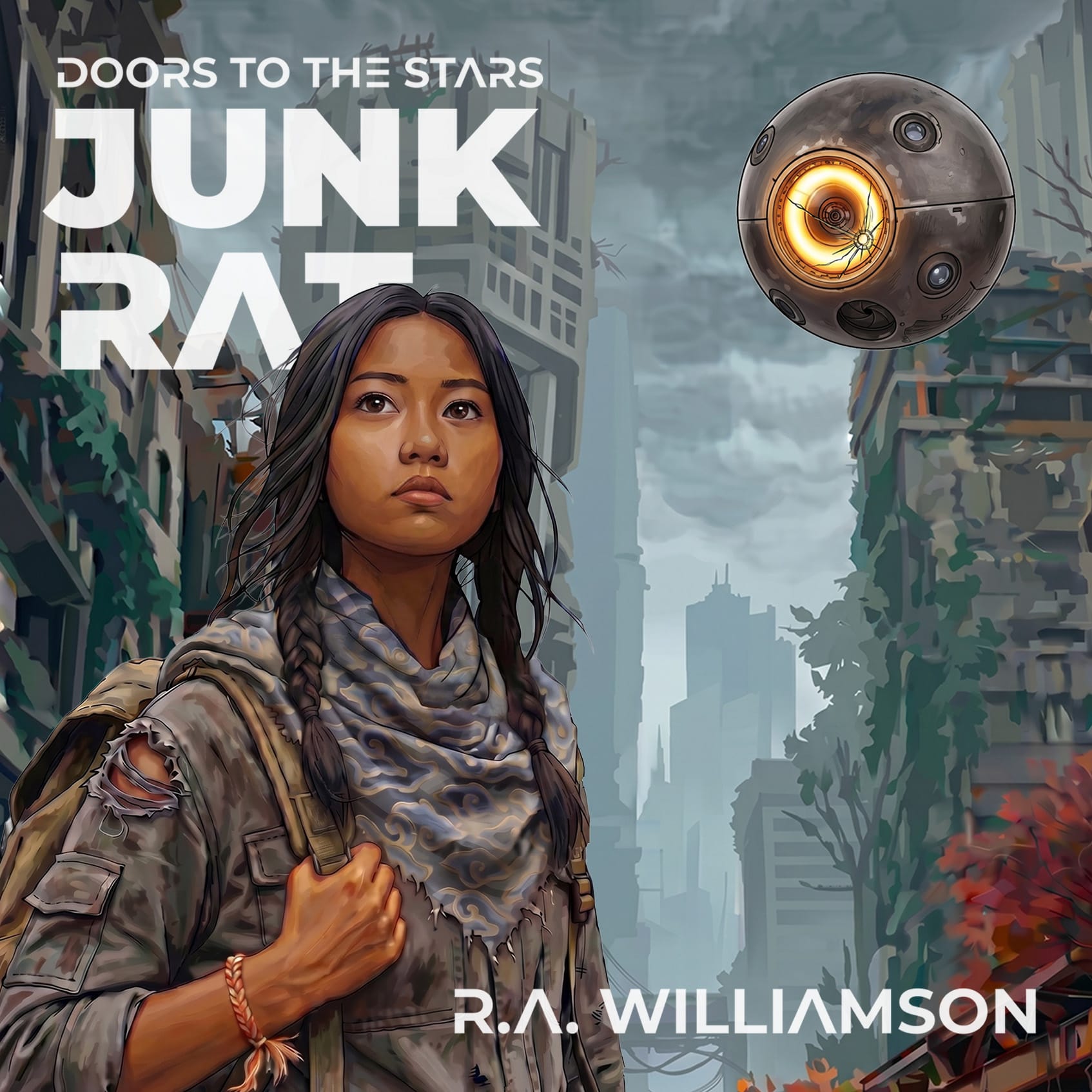
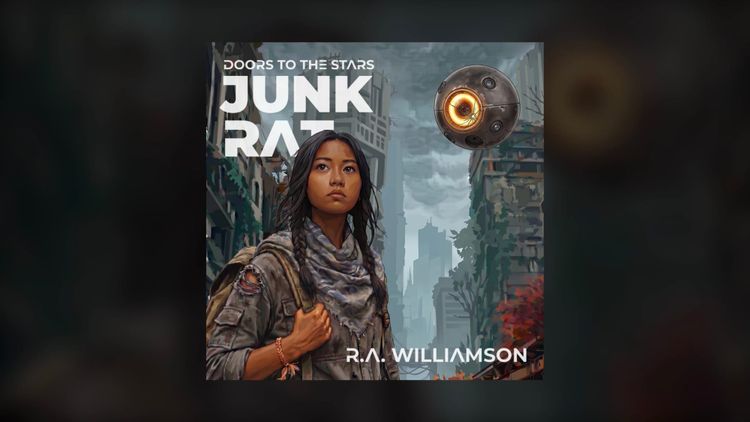
Wulan is fourteen, alone, and running out of time…
Read the exclusive prequel to Doors to the Stars, available free now in eBook and audiobook.
Member discussion