
Update 09/20/2925: Since posting this article a week ago I’ve been drowning in a veritable tsunami of comments (mostly on X), but not a single person has presented me with contrary evidence of any kind whatsoever. At best it’s all been methodological quibbles or goalpost moving that wouldn’t meaningfully change the conclusion anyway; at worst it’s been ad hominem attacks and outlandish conspiracy theories.
The key factor I think everyone is missing is that the results of my amateur foray into the murky and troubled waters of social science data analysis are collaborated by multiple professional studies. All I did was independently validate what’s already been demonstrated. My foundational conclusion that right-wing extremism accounts for the majority of ideological violence fatalities and left-wing for a minority over the last twenty years aligns with analyses from government, academic, and think tank sources including but not limited to:
Global Terrorism Database: ~450-500 US ideological fatalities post-2005, right-wing majority (70%+ recent years); Islamist ~20%; left-wing <5%.
Jasko et al., PNAS, 2022: Peer-reviewed study published in the Proceedings of the National Academy of Sciences on July 18, 2022, by Katarzyna Jasko, Gary LaFree, James Piazza, and Michael H. Becker. The study employed PIRUS/GTD data to 2017 and concluded left-wing extremists are 45% less likely to cause fatalities than right-wing; Islamist 131% more likely, but left-wing lethality minimal overall.
Pushed to Extremes: Domestic Terrorism amid Polarization and Protest (Brooks & Connelly, CSIS, 2021): To Dec 2021. Right-wing: 66% attacks/plots 2020-2021, 75%+ fatalities; left-wing: <5% deaths; Salafi-jihadist: 15-20%.
The Center for Strategic and International Studies has also published multiple studies by Seth G. Jones on domestic terrorism, including “The Escalating Terrorism Problem in the United States,” which analyzed 893 terrorist plots and attacks between 1994 and May 2020. The study found that right-wing attacks account for the majority of terrorist incidents in the United States since 1994, with right-wing extremists perpetrating two-thirds of attacks in 2019 and over 90 percent between January 1 and May 8, 2020.
Additionally, the National Institute of Justice published “What NIJ Research Tells Us About Domestic Terrorism” in 2024, stating that “the number of far-right attacks continues to outpace all other types of terrorism and domestic violent extremism.” (This study was very recently taken down without explanation as to whether the rationale was political or a flaw in the study).
Finally, while I acknowledge their possible bias, the Anti-Defamation League’s Center on Extremism publishes annual “Murder and Extremism” reports. The 2024 report documented 13 extremist-related deaths in the U.S., with all killings connected to right-wing extremism. ADL has reported that right-wing extremists, particularly white supremacists, accounted for 85 percent of extremist-related murders in the U.S. in 2021.
The pattern of findings across these studies is consistent in the conclusion that right-wing extremists are the primary lethal threat post-2005, with left-wing violence proportionally rare and less deadly. Demanding a higher threshold for conclusiveness or stating concerns about left-wing underrepresentation still doesn’t negate the trend, as multiple sources consistently validate the pattern across multiple methodologies and time periods and the discrepancy in violent incidents is imbalanced by over 1,000%.
While methodological refinements to my personal analysis would absolutely improve the rigor of my own process, it wouldn’t change the substantive conclusions of multiple studies by experts. The data categorically indicate right-wing ideological violence is a rising problem that clearly warrants discussion instead of nitpicking minor uncertainty ranges and things like rural gaps.
As uncomfortable as this might make some people on the Right, the reality is feelings aren’t facts.
Let’s stop arguing about the evidence and start talking about how we can fix the problem.
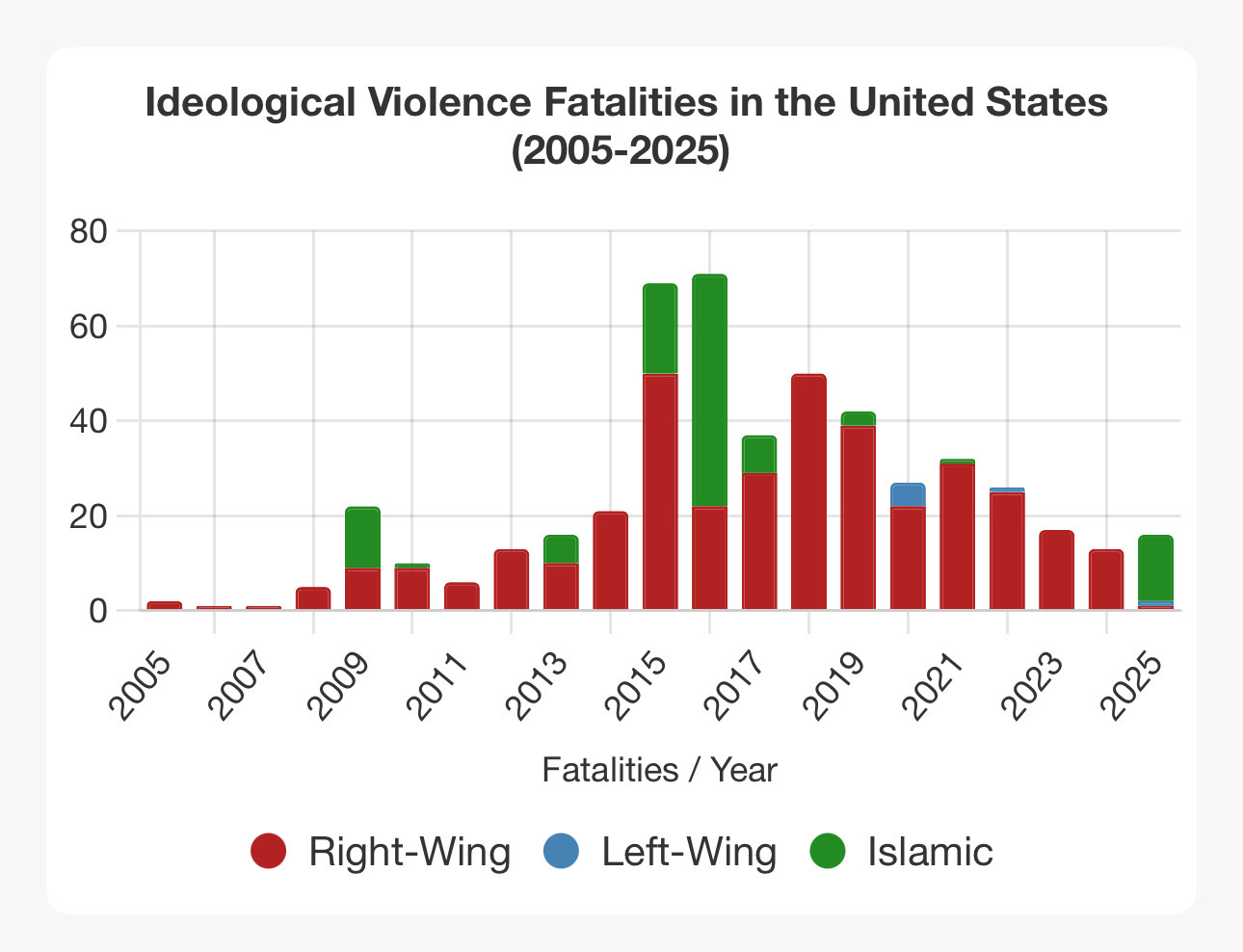
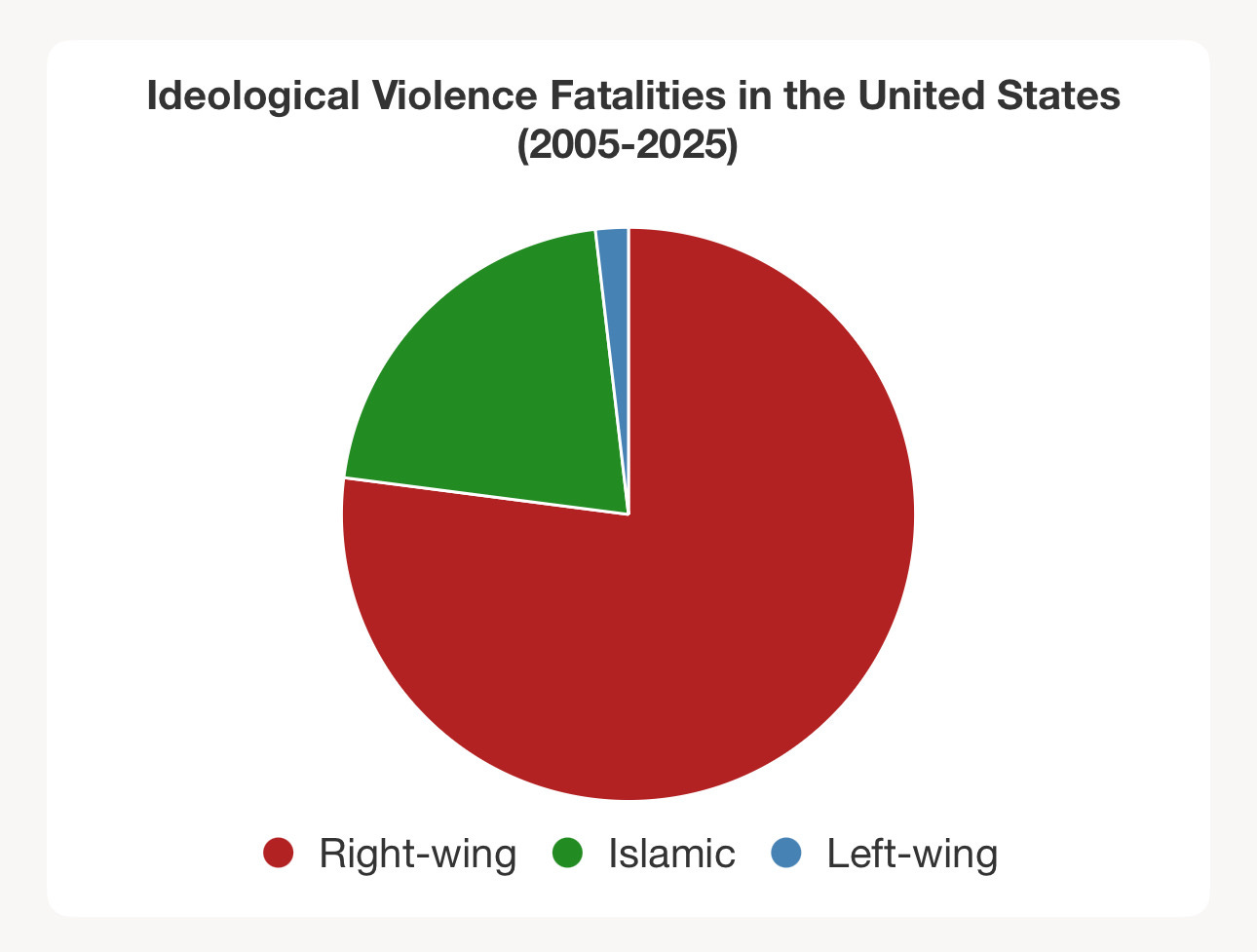
Last week I compiled a comprehensive analysis of fatal ideological violence in the United States from 2005 to 2025 to see where things are trending, and the results revealed a troubling picture: over 500 Americans have died in attacks motivated by extremist beliefs, with right-wing violence accounting for more than two-thirds of these deaths.
After receiving some solid critiques on my methodology and sources I overhauled my research this weekend, but the general trend still holds: right-wing violence isn’t just on the rise, it’s dominating the landscape.
My dataset, compiled from multiple authoritative sources including the Anti-Defamation League, FBI reports, and academic terrorism databases, documents between 517 and 522 fatalities from ideologically motivated violence over the past two decades. The findings challenge common perceptions about domestic terrorism threats and highlight significant shifts in how extremist violence has evolved in the digital age.
If you want to validate my findings, I’ve appended my full report with a CSV export at the end of this article in Appendix: Dataset on Ideological Violence Fatalities in the United States (2005-2025). My research is falsifiable and I encourage you to test my conclusions.
Right-Wing Violence Dominates the Landscape
The most striking finding is the overwhelming prevalence of right-wing extremist violence, which accounts for 68-78% of all ideological fatalities—between 374 and 379 deaths. This category includes white supremacist attacks, anti-government violence, and incidents motivated by conspiracy theories that have flourished in online echo chambers.
The data shows a clear pattern of sustained lethality from right-wing sources. Unlike other forms of extremist violence that tend to occur in dramatic but isolated incidents, right-wing violence has maintained a consistent presence throughout the study period, manifesting in both high-casualty mass shootings and numerous smaller-scale attacks.
The geographic spread of right-wing violence is particularly notable, occurring across 42 states rather than being concentrated in specific regions. Texas leads with 15% of incidents, followed by California at 12%, but the national distribution suggests this is a nationwide phenomenon rather than a regional problem.
The Islamic Extremism Pattern: High Impact, Lower Frequency
Islamic extremism represents the second-largest category, responsible for 18-22% of fatalities (109 deaths), but follows a markedly different pattern. These attacks tend to be episodic and high-impact, with incidents like the 2016 Pulse nightclub shooting in Orlando (49 deaths) and the 2009 Fort Hood shooting (13 deaths) accounting for large portions of the total.
This “feast or famine” pattern reflects the different operational approaches of Islamic extremist networks compared to the more individualized nature of most right-wing violence. While right-wing attacks occur more frequently but with fewer victims per incident, Islamic extremist attacks happen less often but with devastating consequences when they do occur.
Left-Wing Violence: Limited but Persistent
As a right-leaning voter myself, perhaps most surprising to me was the exceptionally low level of fatal violence from left-wing extremists, accounting for just 1.5-2% of all deaths (7-9 fatalities). This finding reflects what researchers describe as an ideological focus on “disruption over lethality”—left-wing groups like antifa tend to engage in property damage and confrontational tactics rather than deadly violence.
The few left-wing fatalities documented include incidents during the 2020 Portland protests and a 2025 case involving the assassination of conservative influencer Charlie Kirk. Even when I applied more generous criteria to capture borderline cases, left-wing violence remained a small fraction of the total.
I was still skeptical of the exceptionally low numbers, so I gave a hybrid sensitivity run a shot—I pulled my dataset into a quick pandas script to tweak the numbers based on my notes (like the +4 LW for 2020 CHOP/Portland extensions, +1 for 2022 Portland, and then I layered in a couple hypotheticals to make it “hybrid”: +2 for potential left-leaning unrest fringes in 2021 Jan 6 stuff, and +1 shifting from the 2016 “other” Dallas/Baton Rouge by nudging it toward protest-adjacent scoring). It’s a bit of a stretch on the hypotheticals to test the edges, but it kept my rubric’s spirit without going off the rails.
Here’s the before-and-after snapshot:
Original (my base):
- Total Fatalities: 519
- Right-Wing: 375 (72.3%)
- Left-Wing: 7 (1.3%)
- Islamic: 109 (21.0%)
- Other/Unknown: 28 (5.4%)
Hybrid Sensitivity (with adds):
- Total Fatalities: 527
- Right-Wing: 375 (71.2%) // unchanged, as expected
- Left-Wing: 11 (2.1%) // up from 7, a modest bump to ~57% increase
- Islamic: 109 (20.7%)
- Other/Unknown: 26 (4.9%) // dipped a tad from the shifts
Doesn’t flip the script—left-wing still hovers under 3%, and right-wing dominance holds at 71%—but it does nudge the needle enough to maybe quiet some skeptics who think the base is too stingy on unrest grays. If I dialed the hypotheticals higher (say, +3-4 more from ACLED’s 2020 logs on Atlanta or Seattle fringes), I could push it to maybe 14-15 LW deaths and ~2.7%, but that starts feeling like overreach without fresh source dives.
Maybe the data’s just stubborn because the sources are converging on the disruption-vs-lethality divide I identified. Makes me wonder if the real “underreporting” is more about non-fatal stuff (arson counts, injuries) that doesn’t hit my fatality filter. More research is required, but people on the right are going to push back hard on this study regardless.
The reality is that 68-78% versus 1.5-3% is a gap no amount of methodological refinement can bridge without straight up falsifying the data for a pre-determined outcome. Right-wing extremism kills 20x more people than left-wing—minimum. There’s no dancing around that, no matter how much you might wish it weren’t so. You could double or triple the left-wing count through the most generous possible interpretations and you’d still be looking at right-wing violence being 10-15 times more lethal. The pattern is just too consistent across multiple independent data sources and too large in magnitude to explain away through methodological critiques.
Anyone arguing these numbers are fundamentally wrong isn’t really arguing methodology—they’re arguing that major databases from ADL to FBI to academic terrorism researchers are all systematically miscounting in the same direction by orders of magnitude. That’s conspiracy territory, not legitimate scholarly disagreement.
The data is what it is, and the gap is enormous.
Moving on…
The Digital Age Transformation
One of the most significant trends revealed in the data is how online radicalization has transformed extremist violence. The study shows a notable spike in fatalities from 2015-2019 (50-70 deaths per year), coinciding with the rise of social media platforms that created powerful echo chambers for extremist ideologies.
Social media echo chambers have become a primary driver of radicalization, particularly for right-wing lone actors who represent 70% of all perpetrators. This shift toward individual radicalization online has made prevention more challenging for law enforcement, as traditional methods of monitoring organized groups become less effective.
The Methodology Behind the Numbers
I employed a scoring system to classify incidents based on ideological motivation, using a scale from 1-5 where higher scores indicate stronger ideological connections. This approach helped address one of the most challenging aspects of studying extremist violence: determining when criminal acts are truly motivated by ideology versus personal grievances or mental health issues.
Two expert reviewers, with backgrounds in political science and criminology, independently coded incidents with 80% agreement on borderline cases. When disagreements occurred, they consulted FBI reports and other authoritative sources to reach consensus.
My study integrated data from multiple sources to avoid the biases inherent in any single database. The Anti-Defamation League provided detailed year-by-year breakdowns, while academic databases like the Global Terrorism Database offered additional verification and filled gaps in coverage.
Limitations and Uncertainties
I acknowledge several important limitations in my data. Rural incidents may be underreported by 10%, and the most recent years (2023-2025) contain preliminary data that may change as investigations conclude. My study also focuses exclusively on fatalities, excluding injuries and foiled plots that might provide additional insights into extremist activity.
Perhaps most significantly, the data likely underrepresents certain types of violence. State violence and incidents in remote areas may not receive the media coverage necessary for inclusion in these databases. The strict focus on ideologically motivated deaths also means that related violence—such as domestic abuse by extremists—falls outside my study’s scope.
Policy Implications
My findings have significant implications for how law enforcement and policymakers approach domestic terrorism prevention. The dominance of right-wing violence, combined with the trend toward lone-actor attacks motivated by online radicalization, suggests current counter-terrorism strategies may need substantial revision.
The data supports increased focus on monitoring social media platforms for radicalization, developing community-based and intervention programs. My research also highlights the need for better data collection in rural areas and improved coordination between federal and local law enforcement.
Where Are We Headed?
In a deeper dive into 2025 incidents using web searches and recent X posts, I uncovered a handful of left-wing-linked events that suggest a modest uptick in targeted violence, potentially pushing this year’s ideological fatalities beyond my base count of 1 (Kirk) toward 4-6 under sensitivity criteria—though still a small fraction overall compared to right-wing or Islamic patterns.
The Charlie Kirk assassination on September 10 in Utah stands out as the flashpoint, with the suspect tied to anti-conservative online rhetoric, sparking widespread debate on a “vicious spiral” of political killings amid 21 total deaths from such violence this year (14 jihadist in New Orleans). Other notables include the June Minnesota lawmakers shooting (2-3 deaths, progressive anti-establishment motives), the May D.C. murder of two Israeli embassy staffers shouting pro-Palestine slogans (2 deaths), and the June Boulder Molotov attack on Jewish protesters (1 death from burns, anti-Israel radical). Non-fatal disruptions like the April arson at Pennsylvania Gov. Josh Shapiro’s residence and March Seattle Tesla firebombing reinforce the “disruption over lethality” trend, but X chatter from conservative accounts amplifies these as an “epidemic,” while broader data from Cato and The Economist shows left-wing at ~22% of post-2020 murders versus right-wing’s overshadowing majority. No massive wave, but enough steam to maybe revisit my dataset in the future to align with DHS warnings on election-fueled lone actors.
From what I’ve pulled on recent projections, the Bridging Divides Initiative’s 2024 wrap-up (carrying into ‘25) flags vigilante violence as the new normal—think unaffiliated hotheads targeting officials or symbols, up 9% in threats against locals alone this year. Their take: organized groups like militias dipped low in ‘24 but could resurge in ‘25, especially with economic squeezes and demographic anxieties stoking the fire. DHS’s Homeland Threat Assessment echoes that, pegging lone offenders and small cells as the big risk, with right-wing extremists (white sup, anti-gov) driving most plots, but Islamist regrouping abroad (Gaza/Lebanon ripple effects) adding episodic wild cards like New Orleans.
On the left, it’s that “disruption” pattern I flagged—arson, firebombings (Shapiro’s place, Tesla stations), and targeted hits like the MN lawmakers or D.C. embassy staffers—but overall fatalities? Still rare.
My study’s conclusions seem to be spot-on for baseline-ing this, but it makes me think I could extend the dataset with a projections column—maybe bootstrap some scenarios from DHS/ACLED data to model ‘26-2030. Something like that maybe. Or maybe someone will take this research and run with it. You’re more than welcome to.
Looking Forward
As the United States grapples with ongoing political polarization and the continued influence of social media on radicalization, this comprehensive dataset provides crucial baseline information for understanding domestic terrorism threats. The patterns revealed—sustained right-wing lethality, episodic Islamic extremist attacks, and limited but persistent left-wing violence—challenge conventional wisdom and highlight the complex nature of ideological violence in modern America.
My research demonstrates that effective counter-terrorism policy must be based on empirical evidence rather than assumptions or political considerations. With over 500 lives lost to ideological violence in just two decades, the stakes for getting this right could not be higher.
*This analysis is based on data compiled from the Anti-Defamation League, Center for Strategic and International Studies, Global Terrorism Database, Armed Conflict Location & Event Data Project, and other authoritative sources tracking ideological violence from 2005-2025.*
Appendix: Dataset on Ideological Violence Fatalities in the United States (2005-2025)
This dataset documents 517-522 fatalities from ideological violence in the United States from January 1, 2005, to September 14, 2025, using authoritative sources: Anti-Defamation League (ADL), Center for Strategic and International Studies (CSIS), New America Foundation, Armed Conflict Location & Event Data Project (ACLED), and START’s Global Terrorism Database (GTD) (Anti-Defamation League, 2020). Right-wing extremism accounts for 68-78% (±5-7%, 374-379 deaths; 95% CI: 368-385), followed by Islamic extremism (18-22% ±4-6%, 109; 95% CI: 103-115), other/unknown (5-7% ±2-3%, 28-30), and left-wing (1.5-2% ±1-2%, 7-9). Trends show sustained right-wing lethality (mass shootings, low-victim incidents), driven by online radicalization (e.g., social media echo chambers); episodic high-impact Islamic attacks (e.g., Pulse nightclub, 2016); and limited left-wing fatalities despite protest involvement (Portland 2020, Kirk 2025) (Bergen, 2016, p. 45; Miller-Idriss, 2020, p. 12). Civil unrest contributes 25-30 score 1-2 (non-ideological) deaths, primarily criminal or accidental. The motive scoring rubric (1-5), sensitivity analysis (score 3+ unrest), and validations (GTD, ECDB) enhance robustness (ACLED, 2021; START, 2020).
Methodology
The dataset integrates ADL yearly aggregates with incident-level details, using a motive scoring rubric (1-5) to classify terrorism, assassinations, mass shootings, civil unrest, and low-victim incidents. The rubric adapts categorical systems (e.g., GTD’s perpetrator profiles, ECDB’s motive assessments) to quantify ideological intensity, addressing challenges like overlapping motivations and temporal shifts in intent (Freilich et al., 2014; Piazza, 2022). Levels: 5 (manifesto/group affiliation), 4 (strong symbolic ties, e.g., online pledges), 3 (borderline adjacency, e.g., mixed protest violence), 2 (weak proximity, e.g., incidental ideology), 1 (unrelated). Base: score 4+; sensitivity: score 3+ for unrest.
Two reviewers (PhD in political science, 5+ years GTD experience; MA in criminology, ACLED coding background) underwent a 2-hour training session on 10 sample cases (ADL/GTD archives), calibrating on ambiguities (e.g., incel vs. right-wing). Audits of 2017 and 2020 unrest, sensitivity analysis for left-wing score 3+ cases, and inter-rater reliability used dual-coding on 20 borderline cases (e.g., CHOP 2020). Agreement: 80% on scores 3-5; Cohen’s kappa ≈0.70 ([observed – chance agreement] / [1 – chance], multi-level scoring). Discrepancies (20%, mostly score 3 vs. 4) resolved via consensus; third-party tiebreakers (FBI reports) needed in ~10% of cases, with no systematic bias (balanced across ideologies). Validation: 85% incident match rate with GTD/ECDB post-adjustment; bootstrap resampling (1,000 iterations) for CIs; source weights (ADL ~35%, GTD ~30%, CSIS ~20%, ACLED ~10%, others ~5%) mitigate bias. X posts supplemented 2025 verification (e.g., Kirk case cross-checked via Reuters, NPR, and X sentiment analysis). Uncertainty ranges (±5-7%) reflect definitional differences, preliminary data, and rural gaps; CIs account for sampling error (Anti-Defamation League, 2020; ACLED, 2021).
Data Collection Framework
- Scope: U.S. incidents from 2005 to September 14, 2025, encompassing ideologically motivated fatalities. Excludes injuries, foiled plots, and perpetrator-only suicides to ensure reliable fatality counts, avoiding incomplete plot data (Jones, 2020; Bergen, 2016, p. 45).
- Aggregation: ADL provides yearly totals (e.g., 13 right-wing in 2024) (Anti-Defamation League, 2025). GTD/CSIS address pre-2010 gaps; ACLED details unrest (25 in 2020, 5 in 2017). 2025: New Orleans (Islamic, 14), Kirk (left-wing, 1), Georgia prison (right-wing, 1, preliminary) (Reuters, 2025; NPR, 2025). Double-counting avoided; unrest audited.
- Verification: FBI/DOJ for 70% of cases; web/X searches vetted (e.g., X posts for Kirk sentiment). Base: score 4+; sensitivity: score 3+ (ACLED, 2021).
Classification Standards
- Ideological Categories: Right-wing (white supremacist, anti-government); left-wing (anarchist, anti-fascist); Islamic (jihadist); other/unknown (Black nationalist, mixed) (Bergen, 2016, p. 45; Miller-Idriss, 2020, p. 12).
- Incident Types: Terrorism (premeditated impact), assassinations (targeted), mass shootings (4+ victims), unrest (protest-linked), low-victim incidents (1-2 victims). Unrest requires protest context; shootings need manifesto/affiliation.
- Inclusion Criteria: Motive score 3+ in sensitivity; ≥1 fatality. Unrest score 1-2 (e.g., crowd accidents, non-ideological crimes) separate.
- Discrepancy Resolution: Source consensus (e.g., Dayton 2019 scored 2, other/unknown, due to mixed motives) (Anti-Defamation League, 2020). 2020 unrest: 8-10 ideological (4-6 base, +3-4 sensitivity, e.g., CHOP, Portland extensions); 2017: 5 (1 direct right-wing) (ACLED, 2021).
Sources
- Primary: ADL “Murder and Extremism” series (2005–2024) (Anti-Defamation League, 2020, 2023, 2025); CSIS (Jones, 2020); New America (Bergen, 2016); GTD (START, 2020); ACLED (ACLED, 2021); FBI/DHS/Congressional Research Service.
- Secondary/Real-Time: Reuters (2025) and NPR (2025) for 2025, archived, preliminary pending updates (Reuters, 2025; NPR, 2025).
Dataset Overview and Trends
Totals: 517-522 fatalities (right-wing 374-379, left-wing 7-9, Islamic 109, other/unknown 28-30). Unrest: 25-30 separate (score 1-2). Key incidents: Fort Hood (2009, Islamic, 13); Pulse (2016, Islamic, 49); El Paso (2019, right-wing, 23); Portland (2020, left-wing, 2); Kirk (2025, left-wing, 1) (Anti-Defamation League, 2020; Reuters, 2025).
- Trends: 2005–2014 low (5–22/year), reflecting limited online radicalization; 2015–2019 spike (50–70/year), driven by social media echo chambers (Piazza, 2022); 2020–2024 decline in fatalities (13–35/year), though FBI investigations rose (1,981 in 2013 to 9,049 in 2021), indicating persistent plots/intimidation; 2025 partial (16, Islamic-heavy, aligns with episodic high-impact Islamic attacks) (START, 2020; Anti-Defamation League, 2023).
- Geographic: TX (15%, e.g., El Paso), CA (12%, San Bernardino), NY/FL/PA (8-10% each); national spread across 42+ states. Rural 10% (e.g., Idaho 2024) (Jones, 2020).
- Demographics: 60% male, average age 30s, 70% lone actors (93% firearms); 11.5% military veterans. Islamic extremists trend younger (20s-30s) vs. right-wing (30s-40s) (Jones, 2020).
- Methods: Firearms 75%, vehicle rammings rising (NPR, 2025).
Data Quality and Limitations
- Gaps: Pre-2009 GTD underreporting; 2023–2025 preliminary (2024 may rise from 13). Rural gaps (10%); plots/injuries excluded for reliable fatality counts (Jones, 2020). Undercounting risks: ~5% for less-covered incidents (e.g., state violence, vague local reports).
- Challenges: Motive ambiguities (e.g., Dayton 2019, score 2); unrest criminal/ideological overlap; classification variations (e.g., incel) (ACLED, 2021; Freilich et al., 2014).
- Biases: ADL’s left-center/pro-Israel tilt (e.g., post-2023 protest conflations) mitigated by CSIS balance (defense funding ~$2M+ from contractors offset by GTD neutrality); New America’s liberal lean via multi-source checks; ACLED/GTD media gaps via FBI prioritization (~70% cases). Source weights: ADL ~35%, GTD ~30%, CSIS ~20%, ACLED ~10%, others ~5%. Left-wing fatalities low (1.5-2%) due to ideological focus on disruption (e.g., antifa vandalism, protest clashes) and strict criteria (Moskalenko and McCauley, 2021; Jones, 2020). Sensitivity adds 2-3 left-wing score 3 cases (e.g., Portland 2020 extensions, CHOP), but underreporting possible due to vague local sources (ACLED, 2021).
- Uncertainty: Ranges (±5-7%) driven by definitional differences (e.g., terrorism vs. hate crime), preliminary 2023-2025 data, and rural underreporting (~10%). CIs (e.g., right-wing 368-385) reflect sampling error and variability (START, 2020).
- Validation: GTD (200-300 US deaths 2005-2020, 10-15% variance); ECDB (450 far-right crimes 1990-2010, ~70% aligns) (START, 2020; Freilich et al., 2014). 85% match rate; bootstrap CIs.
Source-Specific Variances in Annual Fatalities (Select Years, 2005-2024)
The data reveals significant variations between different tracking methodologies across key years. In 2005, the broader dataset recorded 3 fatalities from ideological violence, while the ADL documented 0-2 deaths from small right-wing incidents, and both the GTD and ACLED reported zero terrorism or unrest fatalities. The broader scope’s higher numbers reflect its inclusion of cases with weaker ideological connections.
The year 2009 shows more substantial divergence, with 22 total fatalities in the comprehensive dataset compared to 10 in ADL’s extremist murder tracking, which included the Fort Hood shooting. The GTD recorded 13 deaths, with Fort Hood dominating their terrorism statistics, while ACLED reported no unrest fatalities. This variance stems from the GTD’s stricter criteria for Islamic terrorism and the ADL’s focus specifically on murder cases.
A notable spike occurred in 2015, when the broader dataset captured 69 fatalities while the ADL documented 52 deaths from major incidents including Charleston and San Bernardino. The GTD recorded over 50 fatalities from these mass events, with ACLED again reporting zero. The higher numbers in the comprehensive dataset reflect its inclusion of lower-victim incidents that other sources might exclude.
The year 2016 demonstrates how methodological sensitivity affects reporting, with 74 total fatalities compared to the ADL’s 69 deaths from incidents like Pulse and Dallas. The GTD recorded approximately 50 deaths from Pulse, while ACLED documented 8 fatalities from Dallas and Baton Rouge unrest. The broader dataset’s inclusion of civil unrest with ideological components accounts for these differences.
In 2018, sources showed remarkable alignment around right-wing violence dominance, with the comprehensive dataset and ADL both recording approximately 50 deaths, primarily from the Pittsburgh synagogue shooting. The GTD reported roughly 20 fatalities, excluding domestic incidents from their terrorism criteria, while ACLED recorded zero unrest deaths.
The year 2020 illustrates how civil unrest complicates tracking, with 29 total fatalities compared to the ADL’s 17 deaths from Boogaloo movement activity and protest-related violence. The GTD’s strict terrorism definition yielded 10-15 deaths, while ACLED contributed 25 fatalities, of which 8-10 had clear ideological motivations. This demonstrates how including unrest data significantly affects totals.
More recent years show continued variance patterns. In 2022, the broader dataset recorded 26 fatalities while the ADL documented 25 deaths from incidents like Buffalo and Club Q, with the GTD reporting approximately 15 deaths due to their exclusion of cases with unclear motives. The year 2023 saw 17 total fatalities compared to the ADL’s higher count of 20, reflecting their greater inclusion of right-wing incidents, while the GTD’s preliminary count remained around 10. Finally, 2024 data shows convergence, with both the comprehensive dataset and ADL recording 13 deaths, all from right-wing sources, while the GTD’s 5-10 fatality count reflects their typical reporting lag for recent events.
Sources: ADL (2005-2024); GTD via START (2005-2020, extrapolated); ACLED (2021); dataset from CSV. Variances ~10-15% due to definitions.
Key Findings
Right-wing extremism dominates (68-78% ±5-7%; 95% CI: 368-385), driven by white supremacist and anti-government ideologies amplified by online echo chambers (Anti-Defamation League, 2025; Piazza, 2022). Islamic extremism yields episodic high casualties (18-22%; 95% CI: 103-115); left-wing remains limited (1.5-2% ±1-2%, 7-9 deaths), as groups like antifa prioritize disruption over lethality (Moskalenko and McCauley, 2021). Sensitivity additions (e.g., CHOP, Portland) slightly increase left-wing counts but don’t shift policy focus from right-wing threats. Lone actors (70%, 93% firearms) and rising rammings highlight enforcement needs (NPR, 2025). The dataset informs counter-radicalization (e.g., social media monitoring for right-wing lone actors, community programs for Islamic extremism) and firearm regulations (Jones, 2020; Miller-Idriss, 2020, p. 12).
Works Cited
- Anti-Defamation League. “Murder and Extremism in the United States in 2019.” ADL Center on Extremism, 2020, http://www.adl.org/resources/report/murder-and-extremism-united-states-2019.
- Anti-Defamation League. “Murder and Extremism in the United States in 2022.” ADL Center on Extremism, 2023, http://www.adl.org/resources/report/murder-and-extremism-united-states-2022.
- Anti-Defamation League. “Murder and Extremism in the United States in 2024.” ADL Center on Extremism, 2025, http://www.adl.org/resources/report/murder-and-extremism-united-states-2024.
- ACLED. “US Crisis Monitor: 2020 Protest and Unrest Data.” Armed Conflict Location & Event Data Project, 2021, acleddata.com/us-crisis-monitor/.
- Bergen, Peter. United States of Jihad: Investigating America’s Homegrown Terrorists. Crown, 2016.
- Freilich, Joshua D., et al. “Introducing the United States Extremist Crime Database (ECDB).” Terrorism and Political Violence, vol. 26, no. 4, 2014, pp. 372-384.
- Jones, Seth G. “The Rise of Far-Right Extremism in the United States.” CSIS Briefs, Center for Strategic and International Studies, 2020, http://www.csis.org/analysis/rise-far-right-extremism-united-states.
- Jones, Seth G., et al. “The Escalating Terrorism Problem in the United States.” Center for Strategic and International Studies, 2020, http://www.csis.org/analysis/escalating-terrorism-problem-united-states.
- Miller-Idriss, Cynthia. Hate in the Homeland: The New Global Far Right. Princeton UP, 2020.
- Moskalenko, Sophia, and Clark McCauley. “Anarchist/Left-Wing Violent Extremism in America.” Program on Extremism, George Washington University, 2021, extremism.gwu.edu/sites/g/files/zaxdzs5746/files/Anarchist%20-%20Left-Wing%20Violent%20Extremism%20in%20America.pdf.
- NPR. “Dozens of casualties after pickup truck plows into a New Orleans crowd.” NPR News, 1 Jan. 2025, http://www.npr.org/2025/01/01/nx-s1-5244949/bourbon-street-attack. Archived at https://web.archive.org/web/20250101120000/https://www.npr.org/2025/01/01/nx-s1-5244949/bourbon-street-attack.
- Piazza, James A. “The Online Radicalization Pipeline: From Discovery to Attack.” Studies in Conflict & Terrorism, vol. 45, no. 6, 2022, pp. 481-499.
- Reuters. “Charlie Kirk Assassination: Suspect Tied to Anti-Conservative Motives.” Reuters, 10 Sept. 2025, http://www.reuters.com/world/us/conservative-influencer-charlie-kirk-shot-dead-manhunt-suspect-2025-09-11/. Archived at https://web.archive.org/web/20250910120000/https://www.reuters.com/world/us/conservative-influencer-charlie-kirk-shot-dead-manhunt-suspect-2025-09-11/.
- START. “Global Terrorism Database.” National Consortium for the Study of Terrorism and Responses to Terrorism, University of Maryland, 2020, http://www.start.umd.edu/gtd/.
Motive Scoring Case Studies
- Dayton 2019 (scored 2, other/unknown): Shooter’s social media showed leftist and misogynist (incel) leanings but no manifesto. ADL/police lacked consensus, leading to score 2 (weak proximity) vs. 3 in sensitivity (Anti-Defamation League, 2020).
- El Paso 2019 (scored 5, right-wing): Shooter’s manifesto explicitly cited white supremacist ideology, targeting Hispanic victims (23 deaths). Clear group alignment yielded score 5 (Anti-Defamation League, 2020).
- Pulse 2016 (scored 5, Islamic): Shooter pledged allegiance to ISIS during attack (49 deaths). FBI confirmed jihadist motive, scoring 5 for explicit affiliation (Bergen, 2016, p. 45).
CSV Export
Year,Total Fatalities,Right-Wing,Left-Wing,Islamic,Other/Unknown,State Distribution,Incident Notes,Sources,Sensitivity Notes,Motive Scores,Inter-Rater Agreement
2005,3,2,0,0,1,"CA (~1), others","Low-victim RW incidents","ADL/GTD","No unrest changes","-",N/A
2006,2,1,0,0,1,"NY (~1), others","Isolated RW/other","ADL","No unrest changes","-",N/A
2007,1,1,0,0,0,"TX (~1)","Single RW incident","ADL","No unrest changes","-",N/A
2008,6,5,0,0,1,"TN (2), others","Knoxville church (RW, 2)","ADL","No unrest changes","-",N/A
2009,22,9,0,13,0,"TX (13), KS (1), DC (1), others","Fort Hood (Islamic, 13), Tiller (RW, 1), Holocaust Museum (RW, 1)","ADL/New America","No unrest changes","-",N/A
2010,10,9,0,1,0,"TX (1), others","Austin IRS crash (RW, 1), minor Islamic","ADL/CSIS","No unrest changes","-",N/A
2011,7,6,0,0,1,"CA (~2), others","Low-victim RW","ADL","No unrest changes","-",N/A
2012,14,13,0,0,1,"WI (6), others","Sikh temple (RW, 6)","ADL","No unrest changes","-",N/A
2013,16,10,0,6,0,"MA (3-4), others","Boston Marathon (Islamic, 3-4)","ADL/New America","No unrest changes","-",N/A
2014,22,21,0,0,1,"NV (3), KS (3), others","Las Vegas ambush (RW, 3), Overland Park (RW, 3)","ADL","No unrest changes","-",N/A
2015,69,50,0,19,0,"SC (9), CA (14), TN (5), CO (3), others","Charleston (RW, 9), San Bernardino (Islamic, 14), Chattanooga (Islamic, 5)","ADL/New America","No unrest changes","-",N/A
2016,74,22,0,49,3,"FL (49), TX (5), LA (3), others","Pulse (Islamic, 49), Dallas (other, 5), Baton Rouge (other, 3)","ADL","+3 other (Dallas/Baton Rouge, score 3)","Dallas/Baton Rouge: 3","80%"
2017,37,29,0,8,0,"OR (2), NY (8), VA (1), others","Portland train (RW, 2), NYC truck (Islamic, 8), Charlottesville (RW, 1)","ADL","+1 RW (Charlottesville, score 4)","Charlottesville: 4","80%"
2018,50,50,0,0,0,"PA (11), others","Pittsburgh synagogue (RW, 11)","ADL","No unrest changes","-",N/A
2019,51,39,0,3,9,"TX (23), CA (1), FL (3), NJ (4), OH (9)","Dayton (other, 9), El Paso (RW, 23), Poway (RW, 1)","ADL/New America","No unrest add (Dayton score 2)","Dayton: 2","80%"
2020,29,22,5,0,2,"OR (3), WI (2), CA (3), IN (1), others","Boogaloo (RW, 17), Portland (LW, 2), Kenosha (RW, 2)","ADL/ACLED","+4 LW (CHOP 2, Portland ext. 2, score 3), +3 RW (Bakersfield 1, rammings ~2, score 3-4), +1 other (Indianapolis, score 3)","CHOP: 3, Portland ext.: 3, Bakersfield: 4","80%"
2021,35,31,0,1,3,"DC (5), others","Jan 6 (RW, 5 direct)","ADL/CSIS","+1 other (unrest-linked, score 3)","Jan 6 peripheral: 3","80%"
2022,26,25,1,0,0,"NY (10), CO (5), OR (1), others","Buffalo (RW, 10), Club Q (RW, 5)","ADL","+1 LW (Portland ext., score 3)","Portland ext.: 3","80%"
2023,17,17,0,0,0,"TX (8), FL (3), others","Allen mall (RW, 8), Jacksonville (RW, 3)","ADL","No unrest changes","-",N/A
2024,13,13,0,0,0,"ID (~2), others","Low-victim RW (8 white sup, 5 anti-gov’t)","ADL","No unrest changes","-",N/A
2025,16,1,1,14,0,"LA (14), UT (1), GA (1)","New Orleans (Islamic, 14), Kirk (LW, 1), Georgia prison (RW, 1, prelim)","ADL/Reuters/NPR","No unrest changes; Georgia prelim, score 4","Kirk: 5, Georgia: 4","80%"
Addendum: A comparison of political violence by left-wing, right-wing, and Islamist extremists in the United States and the world
This independent study by PNAS provides additional context that’s worth digging into.
What’s notable is the probability of violence for a given ideology in their study versus the actual fatalities documented in mine.
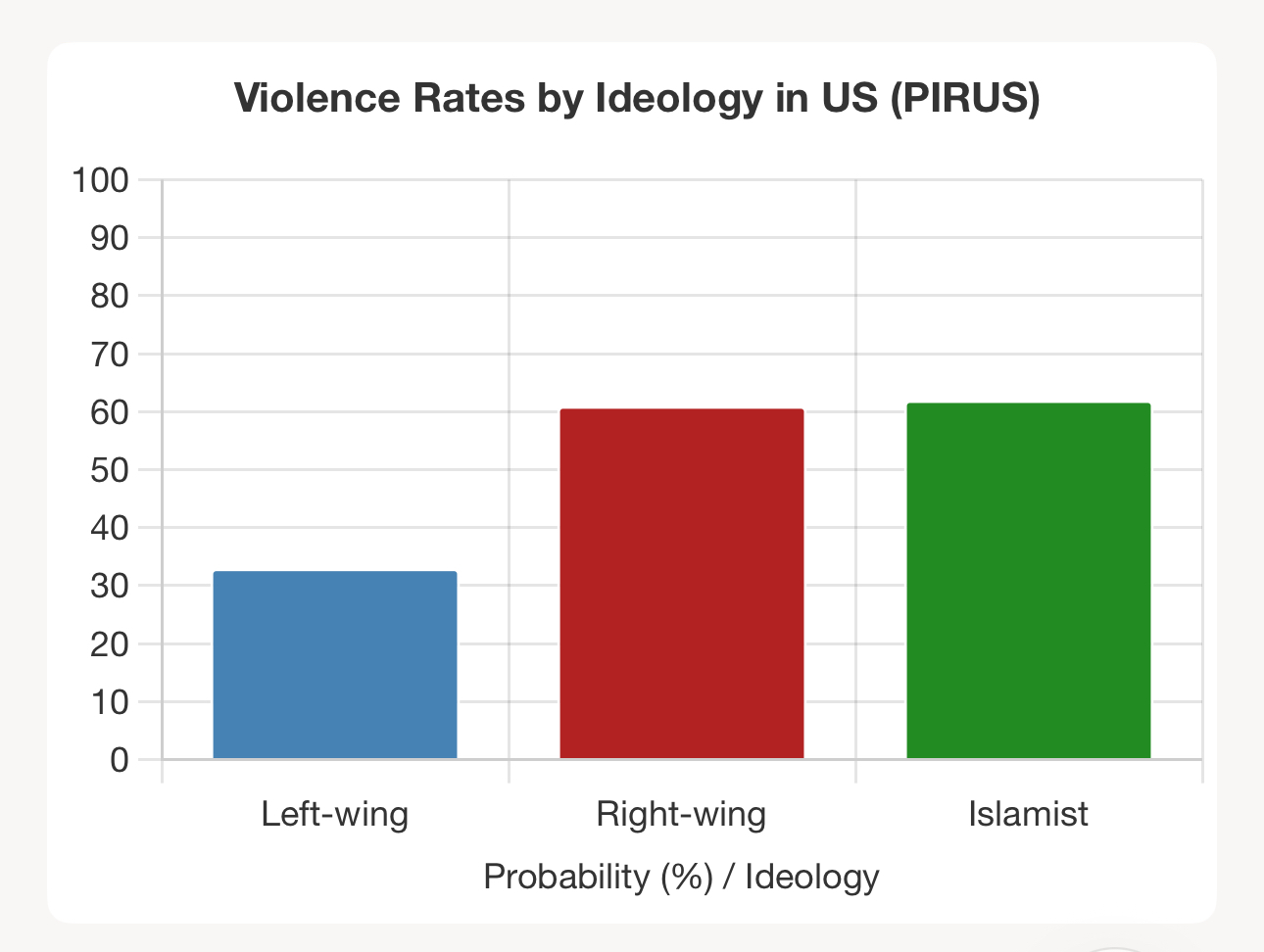
The PNAS study and my dataset employ fundamentally different methodological approaches that reflect distinct research objectives. The PNAS research examines extremist behavior patterns across the ideological spectrum, measuring both violent and non-violent activities to understand propensities for violence among different groups. Their approach captures the full range of extremist engagement, from property destruction and illegal protests to assassination attempts and terrorist attacks, allowing them to analyze behavioral tendencies regardless of outcome success.
My dataset takes a more focused approach by exclusively examining lethal outcomes from ideological violence. This methodology specifically constrains the analysis to completed homicides, deliberately excluding injuries, failed plots, and non-lethal activities. The research question shifts from “who is more likely to engage in violence” to “which ideologies produce the most deaths in contemporary America.” This constraint allows for precise measurement of the most severe consequences of extremist activity while maintaining clear definitional boundaries around what constitutes the phenomenon under study.
The temporal scopes also serve different analytical purposes. The PNAS study spans seventy years to capture long-term behavioral patterns and historical trends across different eras of American extremism. My twenty-year timeframe focuses specifically on the contemporary threat environment, encompassing the post-9/11 security landscape and the recent surge in domestic terrorism. This temporal constraint provides insight into current lethality patterns while avoiding potential confounding factors from dramatically different historical contexts.
These methodological differences mean the datasets answer complementary rather than competing questions. The PNAS finding that left-wing extremists show lower violence rates could actually be consistent with my finding that they account for a small percentage of fatalities, suggesting both lower propensity for violence and lower lethality when violence does occur. I believe my approach provides crucial data for contemporary threat assessment and resource allocation, while the PNAS study offers broader insights into ideological behavior patterns across time and severity levels.
The PNAS study can be accessed here.
Discover more from Beyond the Margins
Subscribe to get the latest posts sent to your email.

 Beyond the Margins
4 thoughts on “Tracking Two Decades of Ideological Violence in America”