
The travesty of Charlie Kirk’s assassination represents everything wrong with our current political moment—the point where disagreement transforms into dehumanization, and dehumanization enables deadly violence.
I’ve said it before, but let me be absolutely crystal clear: anyone celebrating Kirk’s death is morally reprehensible and repugnant. The social media posts mocking his assassination, the TikTok videos laughing at his family’s grief, the graffiti reading “Kill All Charlie Kirks”—these represent the worst of human nature.
In the hours and days immediately following Kirk’s murder, however, I witnessed a growing trend that alarmed me more than isolated sociopaths celebrating violence.
I saw reasonable people—including people I knew personally—begin to adopt the language of war.
The calls I saw weren’t just for accountability against grave-dancers. They were explicit calls for violence against liberals as a group. I saw articles and posts nonstop with rhetoric like “Half the country wants us dead—lock and load.” I watched as people argued that “the left” as a monolithic entity had revealed their “true” nature, that compromise was impossible, that political differences had become existential threats requiring violent solutions.
Four days after Kirk’s death, I posted on X: “Can everyone on BOTH sides stop tribalisming harder please? The enemy is NOT your neighbor or coworker who votes differently from you. Bad actors are creating a false narrative of a division that’s being exaggerated to rip the country apart. It’s so exhausting to watch this happening.”
The response was swift and harsh. I was accused of being “tone deaf,” of false equivalence, of minimizing conservative grief while liberals celebrated their victory. Critics argued that I was asking the right to show restraint while the left showed none.
The replies illustrated precisely the mindset I was trying to counter. One user mocked my claim that division was being exaggerated, asking if I lived “with your head in the sand.” Another rejected any possibility of reconciliation: “There is no more middle ground. There is no more discussion.” Several responses explicitly embraced tribal warfare: “People just saw their neighbors and coworkers cheer for innocent blood to be spilled—we tribalize or die.”
Most telling were the responses that treated my call for unity as evidence of the problem. Or worse, that I was personally part of the problem. When I suggested that our neighbors weren’t enemies, users replied that “the Left” had revealed themselves as irredeemable threats. All of them. Half the country. People said things like “September 10th is our October 7th,” as if hoards of slavering Liberals are about to descend from the hills to embark in an orgy of rape and murder while they burn our children in their beds. (Which is preposterous, hysterical, and frankly offensive given what the Israelis have endured.)
But the logic was clear: if you’re not with us in total war against “them,” you’re enabling “them.”
Or worse, one of “them.”
The other.
The threat.
The enemy.
I can understand why it might feel that way to some people. Emotions were raw. They still are. Conservatives had just witnessed one of their most prominent and beloved voices murdered, then watched in growing horror and disgust as fringe liberals celebrated it online. My call for unity must have felt like being asked to turn the other cheek while being punched in the face.
My intent wasn’t criticism of justified anger at grave-dancers, but the dangerous slide toward viewing all political opponents as enemies deserving violence. When any group starts justifying violence against their political opponents, that’s not grief—that’s the embryo of civil war.
The division I called “manufactured” wasn’t the pain of loss or anger at celebration. Those emotions are real and justified. The manufactured part was the leap from “some liberals are assholes” to “liberals are existential threats who only understand force.” That’s the logic bad actors use to transform isolated incidents into broad justifications for violence—amplifying fringe voices to make them seem representative of entire populations.
My exchange with bestselling author Larry Correia when he replied to my post illustrated this all too well. Correia is no extremist—he’s a thoughtful guy with legitimate grievances about political double standards. But reasonable frustration can quickly transform into something potentially darker if it’s left unchecked.
When I suggested we avoid treating neighbors as enemies, Correia responded that the “mask had slipped” and conservatives now saw liberals’ true nature. When I pointed out that we’re still a functioning democracy debating policy, not existential threats, he argued we’re in a “political war” rapidly approaching a “real one.” When I asked about his reference to “gentle Mormon grandmothers contemplating” extreme actions, he said this “absolutely vindicated” his position because these people needed “something to satisfy their righteous anger”—and that “something” was getting people fired for celebrating political violence.
Which, in of itself, is probably fair.
While I’m anti-cancel culture, advocating for consequences against bad actors as an alternative to violence isn’t a position I’d necessarily oppose. His solution was mostly reasonable. The troubling part was his framing—treating half the country as the enemy and ordinary Americans contemplating violence as validation of his worldview, rather than a warning sign of democratic breakdown.
If gentle Mormon grandmas are getting ready to grab their rifles and take to the streets, we should be alarmed, not feel vindicated.
Correia’s reasoning followed a familiar pattern: first, catalog genuine grievances (conservative cancellations, media bias, political persecution). Second, use isolated examples of extremism to paint the entire opposition as irredeemably hostile. Third, argue that de-escalation is impossible because “they” won’t participate in good faith. Finally, frame escalation as inevitable self-defense rather than choice.
This is the same logic every side uses to justify escalation: “We have to fight because they won’t make peace.” It becomes a self-fulfilling prophecy where both sides wait for the other to de-escalate first, making escalation inevitable.
Correia said what I was doing was no different than demanding Israel stand down while Hamas continues to lob rockets at them and hold hostages. But his analogy is fundamentally flawed because it mischaracterizes the relationship between American political opponents. Hamas literally wants to exterminate all Jews. American liberals want social reforms and policy changes. The “threat” from them is mostly… voting differently and saying mean things online or canceling people they disagree with. Violence is sporadic and contained, and statistically limited to property damage. Don’t get me wrong—liberals aren’t blameless. Beyond the vile grave-dancers, many dismiss conservative concerns as paranoia or bigotry, refusing to engage in good faith. This fuels the cycle of mistrust, pushing both sides toward extremes.
But repeatedly citing the “sins” of the Left while painting the Right as passive victims isn’t engaging in reality. The data shows conservatives are statistically safer from political violence than liberals.
The empirical evidence contradicts the rhetoric driving this escalation. Many people have studied this. I’ve studied this. When I attempted to chart the trend of “rising leftist violence” so many were claiming, what I found was the exact opposite. From 2005-2025, right-wing extremism accounted for an escalating 68-78% of ideological violence fatalities in America, while left-wing violence claimed a tenth of that (and that’s using the most aggressive interpretation of the data possible to identify left-wing perpetrators). A 2022 PNAS study found left-wing actors significantly less likely to engage in violence than their right-wing counterparts.
Furthermore, hate crimes against immigrants, minorities, and LGBTQ+ are on the rise—something that concerns me greatly because it directly threatens my most immediate loved ones.
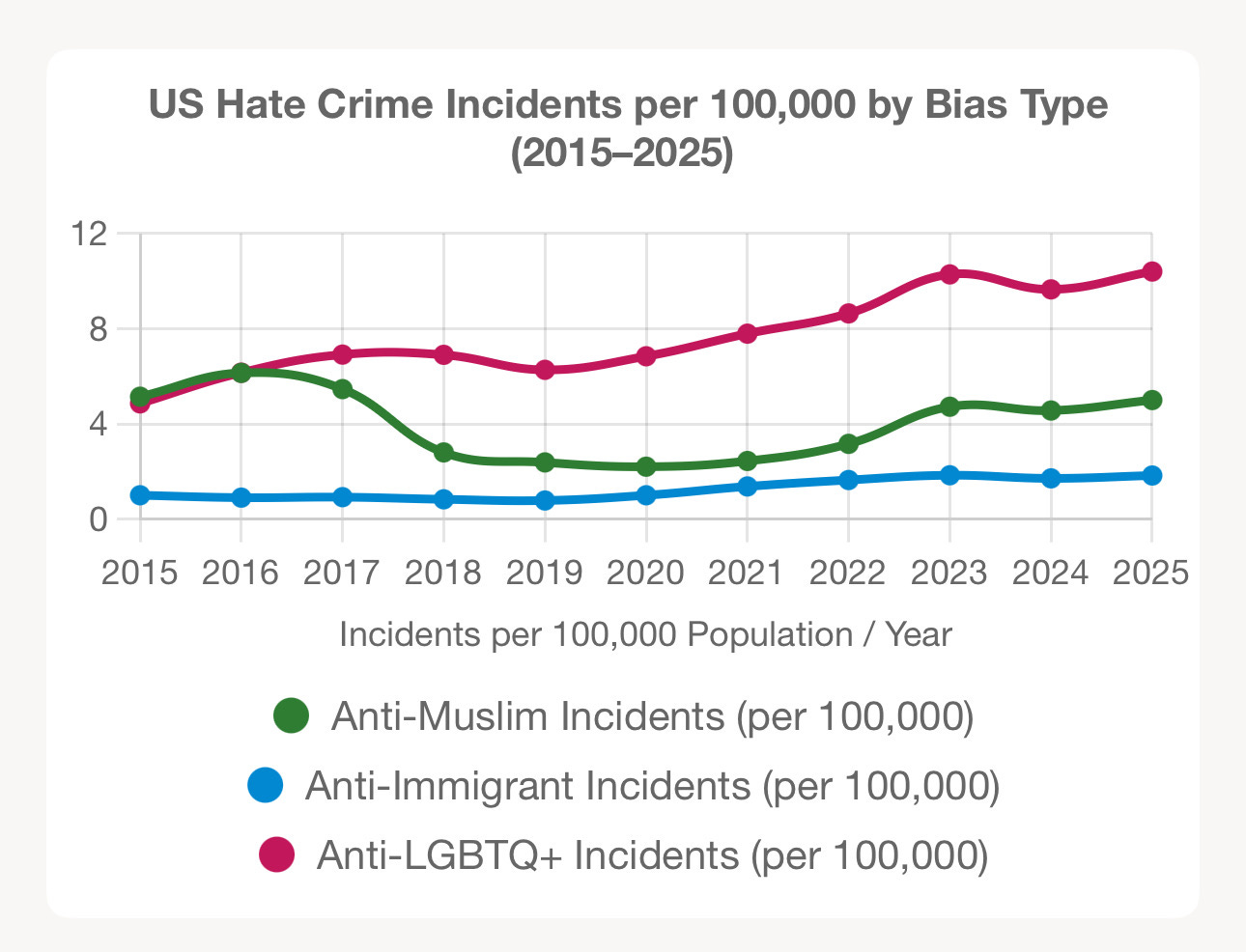
This doesn’t minimize the horror of Kirk’s assassination or excuse left-wing violence. Murder is murder, and hate is hate, regardless of ideology. My point is not to engage in whataboutism, but to correct the false narrative that conservatives are under deadly siege from a uniformly violent left numbering in the tens of millions.
Because we aren’t.
The real pattern is that America has always had fringe actors on both sides willing to use violence, but these extremists don’t represent broader populations. While some liberals celebrated Kirk’s death online, the vast majority of Democrats actively condemned it, with leaders and public figures from Biden, Obama, Harris, and on down the line explicitly rejecting political violence. Most Republicans oppose political violence too. The problem is that social media algorithms and bad-faith actors amplify the worst voices, making fringe positions seem mainstream. Accounts like @libsoftiktok, with millions of followers, compile disgusting examples of a small fringe to paint entire political movements by their most extreme members.
When tragedy strikes, we face a fundamental choice: do we use it to build bridges or burn them? Do we distinguish between extremists and ordinary people, or do we use extremists to justify viewing entire populations as enemies?
I wasn’t being tone deaf when I called for de-escalation. I was watching the early stages of how democracies die—when grief becomes grievance, grievance becomes dehumanization, and dehumanization enables atrocities. When “gentle grandmothers” start contemplating violence, we’ve crossed a line that’s very difficult to uncross.
The people celebrating Kirk’s death deserve condemnation and consequences. But using their moral bankruptcy to justify viewing half the country as enemies worthy of violence is exactly what the bad actors want—be they social media firebrands, algorithmic amplification, partisan operatives, or foreign agents provocateur. They profit from chaos, division, and conflict. They want us to see neighbors as threats, coworkers as enemies, fellow Americans as foreigners.
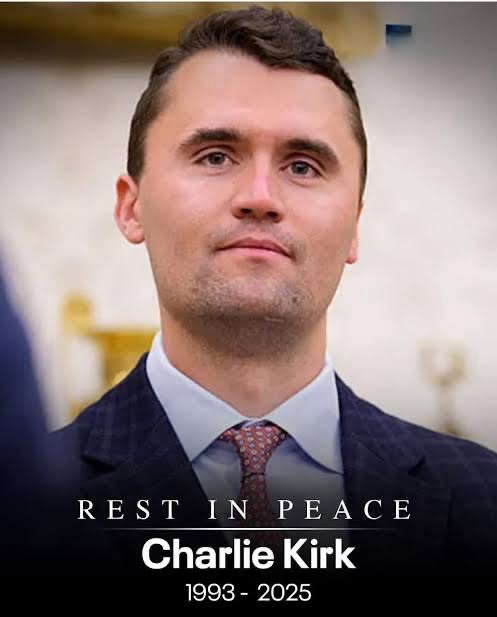
Charlie Kirk deserved far better than assassination. He also deserves better than having his death used to justify the very divisions he spent his life fighting. The best way to honor his memory isn’t to embrace the logic of civil war, but to reject the forces trying to tear our democracy apart.
This isn’t a zero sum game. The choice isn’t between winning and losing. It’s between preserving a system where we can disagree without killing each other, or abandoning it for something much darker. I know which side Charlie would have chosen.
We should choose it too.
Discover more from Beyond the Margins
Subscribe to get the latest posts sent to your email.

 Beyond the Margins
3 thoughts on “When Grief Becomes Justification for War”