
Everyone knows the Golden Rule. No, not the one about being nice to people. The other one: never put links in your original posts on X/Twitter.
The algorithm will suppress them.
Children will suffer.
Put your links in the replies instead.
We’ve heard this everywhere. Growth hackers swear by it. Social media marketing guides treat it as gospel. Even Elon Musk himself has weighed in, telling users to “write a description in the main post and put the link in the reply.”
It sounds logical. It’s repeated constantly by every social media expert with a blue checkmark and a course to sell. And according to my data, it’s completely backwards.
I fell for it too. For months—years!—I dutifully put my links in replies like a good little content creator, watching my traffic… not improve. So I decided to do an A/B test—posts with links in the original, posts with links in replies. Tracked impressions, clicks, click-through rates. The results weren’t ambiguous. Original posts with links drove about 1.5x the traffic despite the algorithm penalty.
Here’s why the conventional wisdom is wrong, why even Musk’s own advice doesn’t work, and what the data actually shows about link placement on X. Spoiler: sometimes the simplest explanation is correct, and we’ve been overthinking this.
The Algorithm Suppression Is Real (But That’s Not The Problem)
Let’s start with what everyone gets right: X’s algorithm does suppress posts with external links. This isn’t some conspiracy theory cooked up by bitter bloggers—it’s stated company policy.
Musk acknowledged this directly in 2023: “Our algorithm tries to optimize time spent on X, so links don’t get as much attention, because there is less time spent if people click away.”
The platform wants to keep users scrolling, not send them to your website. (Shocking revelation: billionaire who owns social media platform wants you to stay on his platform. More at 11.)
So posts with links get less reach than posts without them. This is documented, verified, and the entire reason for the “put links in replies” advice that’s become social media gospel.
Social media marketing guides have adapted accordingly. SocialBee, a popular social media management platform, advises: “When you include a link in your main tweet, it often results in lower engagement because the algorithm downgrades these posts in the feed. To keep your content visible and engaging, consider placing links in the comments.”
Symphonic Blog is even more direct: “Twitter’s algorithm marks links negatively, and often considers it spam. If you do want to share a link, you can share it safely below within a thread instead.”
The logic seems airtight: algorithm suppresses links in original posts, so hide your links in replies to get around the penalty. Problem solved. Pack it up, boys. We’ve beaten the algorithm.
Except we haven’t.
How I Tested It
I’m an author trying to drive readers to my work. Every click matters. So when I noticed my carefully optimized link-in-the-reply-method posts weren’t bringing the boys to my yard, I decided to do some Science™ and run two sets of posts promoting similar content—books, articles, writing-related material. Same audience, same time periods, same topics.
(In the marketing business we call this A/B testing.)
Original method: Link brazenly included directly in the original post (displays a clickable social media card)—you know, like a bloody heathen.
Reply method: Teaser post with eye-catching graphic and clever 🔗⤵️ emoji call-to-action (CTA if you’re a marketing guru) with the link itself in a self-reply—like a sophisticated social media professional who definitely knows what they’re doing.
I tracked three metrics:
- Impressions: How many people saw the post
- Link clicks: How many people clicked through
- CTR (click-through rate): Percentage of viewers who clicked
I also tracked something most people ignore: for the link-in-reply method, how many people who saw the original post actually saw the reply with the link too.
(This turned out to be the important part. Spoiler alert: not many.)
The Surface Results: Links in Original Posts Win
The top-line numbers weren’t close. They weren’t even in the same zip code.
Original posts with links:
- Average impressions: 413
- Average clicks: 11.5
- CTR: 2.79%
Reply posts with links:
- Average impressions: 178
- Average clicks: 8
- CTR: 4.49%
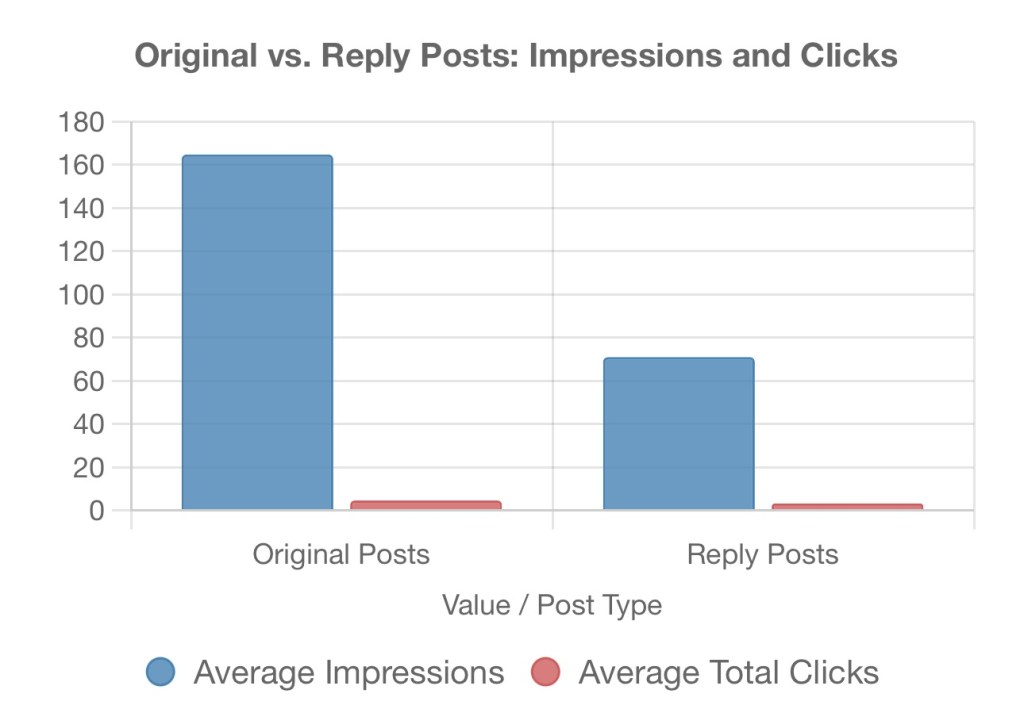
Original posts with links got 2.3x more impressions and 44% more clicks than the self-replies with links. If you’re trying to drive traffic, the data says put your link in the original post. Period. Full stop. End of article.
Thanks for reading and please remember to like, share, and subscribe.
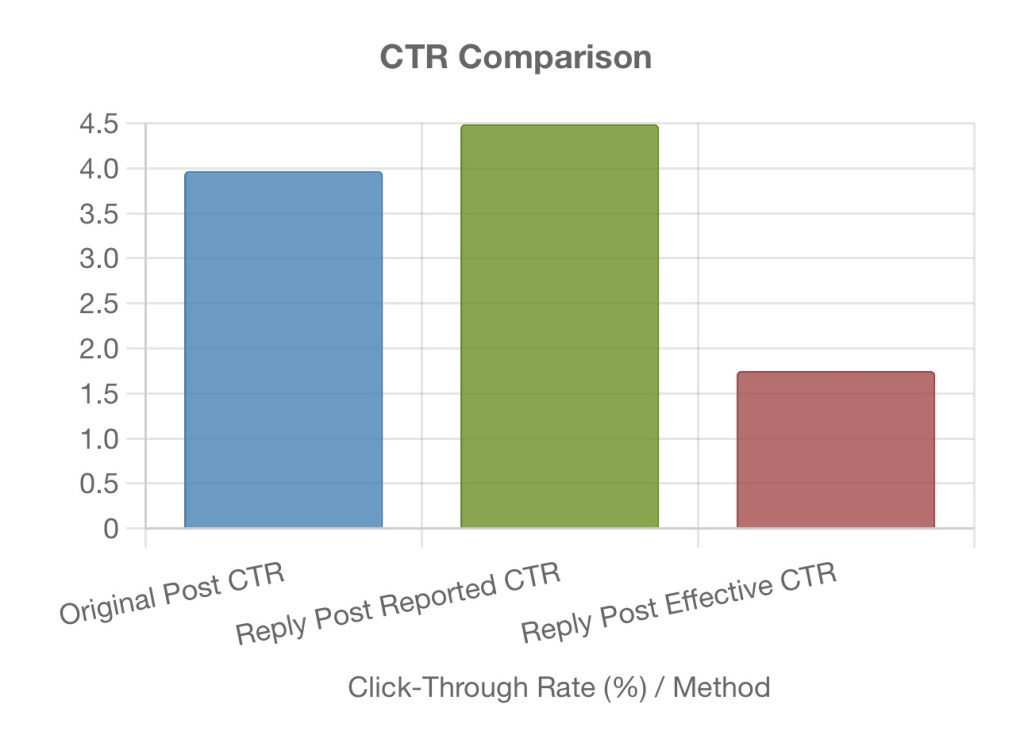
But wait—look at that CTR! Reply posts have a higher click-through rate (4.49% vs. 2.79%). Doesn’t that prove they work better? Isn’t CTR the sophisticated metric that separates the professionals from the amateurs?
No. Because CTR measures the wrong thing. And this is where it gets very interesting. (So thanks for sticking around.)
The CTR Illusion
CTR tells you what percentage of people who saw your link clicked it. It sounds like the right metric. It’s the one all the marketing courses teach you to optimize for. Better conversion rate = better performance, right?
The problem is hidden in that innocent little phrase: “people who saw your link.”
With the link-in-reply method, most people never see your link at all.
Let me show you some advanced calculus here. (Don’t worry, I’ll use small words.)
The Massive Drop-Off: What Nobody Tells You
Here’s where the conventional wisdom doesn’t just stumble—it falls flat on its face and we all laugh at the poor stupid kid.
I didn’t just compare reply post impressions to original post impressions. I compared how many people saw the teaser post versus how many saw the reply containing the link. You know, the reply with the link that’s supposedly “safe” from algorithm suppression.
Turns out, it’s not safe from human behavior. And human behavior is way worse than any algorithm. On average, little more than one third of people who saw the original post expanded the thread to see the reply. 61% of the audience never saw the link at all.

Not “61% saw it but didn’t click.” Not “61% thought about it but decided against it.”
Nearly two-thirds never even knew the bloody link existed.
This is the fatal flaw nobody talks about. We’re so busy optimizing CTR and gaming the algorithm that we forgot to check whether anyone actually sees what we’re optimizing for.
The algorithm isn’t your enemy. Human behavior is. People scroll. They don’t expand every thread. They don’t read every reply. They see your teaser, think “huh, neat,” maybe slap a like on that puppy, and totally ignore your call to action (link below!) and keep scrolling. Your carefully crafted link sits there in a reply gathering dust while you celebrate your improved CTR.
The Real Math: Effective CTR
Let’s walk through what actually happens with each method. Get your calculator out. (Just kidding—this is third-grade math.)
Link-in-Reply method:
- 100 people see your teaser post
- 39 people expand thread to see reply (61% scroll past like it’s their ex at a party)
- Of those 39, about 1.75 click the link (4.49% CTR—looking good on paper!)
- Effective result: 1.75 clicks per 100 viewers
Link-in-Original method:
- 100 people see your post with link (no hide-and-seek required)
- About 2.79 people click the link (2.79% CTR—looks worse! Oh no!)
- Effective result: 2.79 clicks per 100 viewers
Wait a second… I have dyscalculia (too much LDS in my youth), so math is hard for me.
*Gets calculator. Checks again. Checks third time.*
The “worse” method gets more clicks?
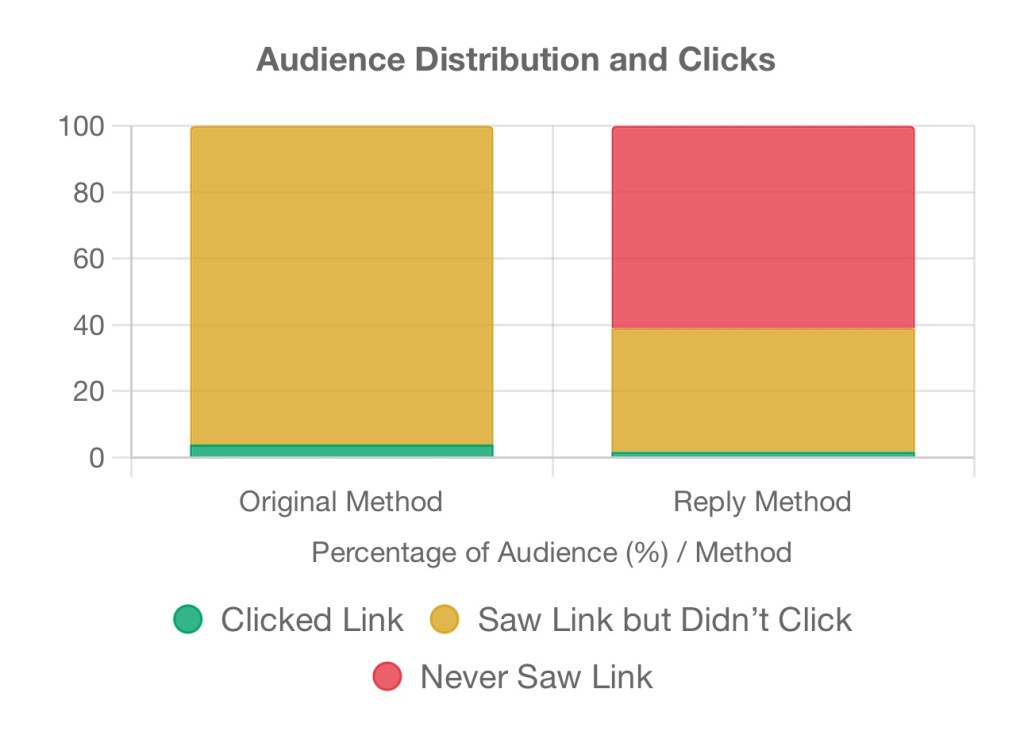
The recommended link-in-reply method creates a two-step conversion funnel:
- First barrier: Expand thread (61% failure rate)
- Second barrier: Click link (95.51% failure rate)
- Combined: 98.25% of your audience never clicks
The original method has one step:
- Single barrier: Click link (97.21% failure rate)
This is Marketing 101. Every barrier you add loses people. The reply method’s “better CTR” is calculated on a fraction of your actual reach. It’s like bragging about your 100% free-throw percentage when you only took one shot.
When you account for two out of three people who never see your reply, the effective CTR drops to 1.75%—less than two-thirds of the original method’s 2.79%.
But hey, at least your analytics dashboard looks good.
The Algorithm Penalty vs. The Visibility Penalty
“But Ryan,” you’re saying, “what about the algorithm suppression? That’s real!”
Yes. Yes it is. I’m not denying it. Posts with links get suppressed. By something like ~30%. This is documented fact.
But here’s what the data shows: even with algorithm suppression, original posts with links got 2.3x more impressions than self-replies with links (413 vs 178 average).
Why? Because original posts get shown to your full potential audience, even if that audience is suppressed by the algorithm. Replies only get shown to the subset of people who choose to expand threads. Which, as we’ve established, is less than 2/5th of your audience on a good day when the algo gods are smiling on you.
The trade-off:
- Algorithm suppression: ~20-30% reach penalty (rough estimate based on various studies)
- Reply visibility: almost two out of three people never even see the damned link
I’ll give you a moment to figure out which number is bigger. Take your time. God knows I had to.
61% loss is twice worser than 30% loss. This isn’t controversial. This isn’t opinion. This is literally just comparing two numbers.
What About That Higher CTR Though?
“But the reply method has higher CTR! You said so yourself! 4.49% vs 2.79%! That’s a 61% improvement!”
Yes. It does. The reply method genuinely has better CTR. People who expand threads are more engaged. This is real.
You’re also optimizing for the wrong metric.
You’re getting better conversion on a little less than two-thirds fewer people seeing your link. It’s like celebrating a restaurant that has a 50% conversion rate on visitors who order food while ignoring the fact that 70% of people who walk past never come in because there’s no sign on the door.
The sign is your link. You hid the sign. Congratulations on your great conversion rate. Gold star for you.
Listen, at the end of the day you can have better CTR or more clicks. Pick one. (Hint: if you’re trying to drive traffic, pick clicks.)
Why Everyone Gets This Wrong
Mistake #1: Trusting the social media guru industrial complex
Big Guru optimizes for metrics that look good in screenshots and sound impressive in their courses. “I increased CTR by 61%!” makes a great testimonial. “I drove 44% more traffic but my CTR looks worse” doesn’t fit in a tweet and makes people ask uncomfortable questions.
Small business advice sites amplify the message: “Musk has suggested a potential solution: businesses can place their links in the replies to a tweet, rather than in the main tweet itself, to avoid the algorithm’s penalty.”
The advice comes from Musk himself, so it must be right. Except Musk is optimizing for keeping users on X, not for helping you drive traffic off X. His incentives aren’t aligned with yours. He wants you to keep people on his platform. You want to get people to your platform.
These are not the same goals. Diametrically opposite goals, in fact. Shocking, I know.
Mistake #2: Algorithm obsession
We’re so focused on “gaming the algorithm” that we forgot about user behavior. The algorithm isn’t hiding your reply from people. Your audience is choosing not to click through to read it.
This is the part that kills me. We’ve spent years obsessing over algorithmic suppression, running A/B tests, optimizing every variable, reading tea leaves, sacrificing chickens to the engagement gods… and we forgot to check whether people actually expand threads to read replies.
Turns out: they don’t. Most people see your post, decide whether it interests them in about 0.3 seconds, and keep scrolling. They don’t think “Hmm, I wonder if there’s additional context in the replies that might change my assessment of this content.”
Even though you explicitly put a call-to-action to “see link in replies” in the post! (And if you didn’t… I can’t help you.)
They just scroll. This ain’t exactly a mystery. This is how social media has worked since the launch of MyFaceTube back when dinosaurs still roamed the earth.
Mistake #3: Ignoring the conversion funnel
Every step in a conversion funnel loses people. Marketing 101. Ecommerce 101. Literally every discipline that involves getting people to do things knows this.
The reply method adds an unnecessary step:
- See post → Decide if interesting → Expand thread → See link → Decide if worth clicking → Click link
The original method removes it:
- See post with link → Decide if worth clicking → Click link
Simpler always converts better. This is not controversial. This has been proven approximately 847,000 times across every industry that involves conversions. (And trust me. I was a missionary. White shirt and tie and all. I’m something of an expert in converting people.)
But somehow, on X/Twitter, we convinced ourselves that adding a step would improve performance because… the algorithm? The vibes? Mercury was retrograde in Uranus?
What You Should Actually Do
Here’s the part where I give you actionable advice. (You’re welcome.)
Put your links in your original posts.
Just do it. Stop overthinking. Accept the algorithm penalty. Yes, you’ll get less reach than a post without a link. But you’ll get more reach—and way more clicks—than hiding your link where almost two-thirds of your audience will never ever see it.
The algorithm suppression is real. The reply method makes it worse.
Stop fretting over optimizing link placement.
And yeah, the difference between 8 and 11.5 clicks per post is marginal. It’s noise. So just opt for the simpler route and put your links in your original post. If you want 10x more traffic, focus on creating content people actually want to click on, not on whether you put the link in the original post or buried it in a reply like you’re playing hide the sausage with your audience.
Maybe not the best simile. Moving on…
Write better hooks. Make better content. Build a better product. Those things matter. Link placement? Distant fourth.
Track what actually matters.
Not CTR. Not impressions alone. Not engagement rate or virality coefficient or whatever metric the gurus are selling this week.
Total clicks. That’s it. That’s the metric.
If you’re an author trying to get readers to your work, a business trying to drive customers to your site, or a creator trying to build an audience off-platform, you need actual clicks. Not impressive-looking conversion rates on invisible links. Not screenshots for your portfolio. Not guru-approved tactics.
Clicks. The thing where someone sees your link and goes to your website. Remember websites? Where people can actually throw their money at you? Yeah, those. Make it easier for people to give you their cash, not harder.
Yeah. Optimize for that.
The Bottom Line
The link-in-reply advice is based on a real observation (algorithm suppresses links) and a logical-sounding solution (avoid the suppression by hiding links in replies). The reasoning makes sense. The logic checks out. The experts all agree.
And it’s still wrong.
Because it misses the critical variable: visibility. Most people don’t expand threads. They don’t read replies. They scroll past your teaser and never know your link exists. Your higher CTR is calculated on the paltry third who happened to expand the thread, not the 100% who saw your post.
The data is unambiguous:
- Links in original posts: 2.3x more impressions, 44% more clicks
- Links in reply posts: better CTR on far, far fewer people who actually see the link, thus fewer click-throughs
The algorithm penalty is real. The link-in-reply method makes it worse.
Stop listening to social media gurus optimizing for engagement metrics that sound good in their courses. Stop trying to outsmart the algorithm with clever hacks. Stop hiding your links in replies like you’re ashamed of them.
Boldly slap your links up where people can actually see them: in your original posts. Accept the modest algorithm penalty. Get more clicks anyway. Get Paid.
The “common wisdom” has it backwards. The math is simple. The data don’t lie.
And yes, I’m aware of the irony of writing a 3,000-word article telling you to keep things simple. Do as I say, not as I do.
Now go forth and stop overthinking your link placement. Make better content instead. Your CTR might look worse in your analytics, but your traffic will be better. That’s the trade-off.
P.S. I couldn’t find another living soul anywhere who has studied this phenomenon. My data sample was admittedly paltry and my methodology was probably crap. If you find a proper peer-reviewed study send it my way. For now I’m going with my gut and not hiding my links in the replies to fester and rot for all eternity.
Discover more from Beyond the Margins
Subscribe to get the latest posts sent to your email.

 Beyond the Margins