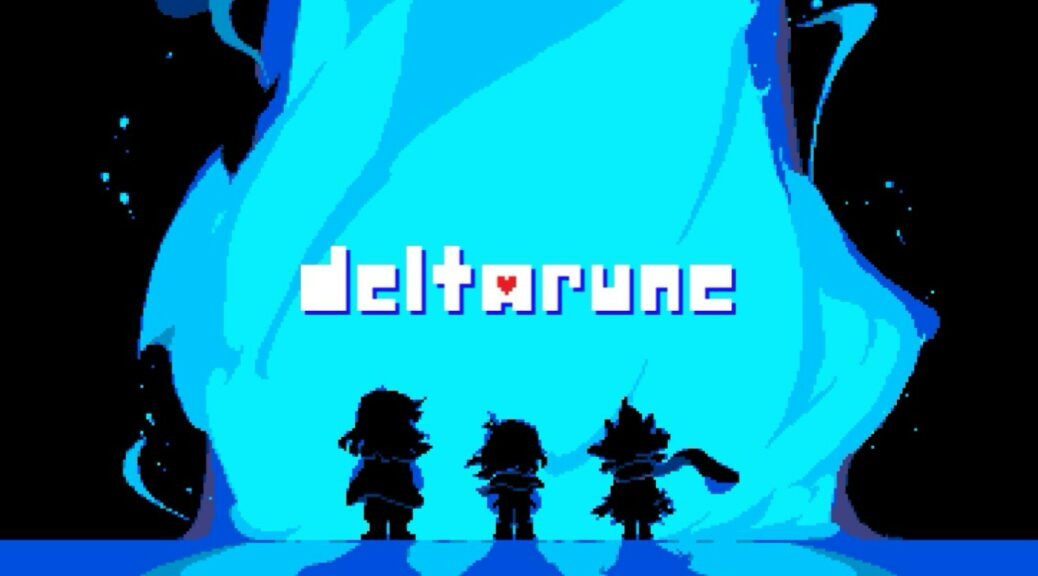
“Your choices don’t matter.”
If you’re a Deltarune fan, that line probably haunts you. It’s tattooed on the back of your brain. Toby Fox dropped it like a bomb in Chapter 1, and we’ve been grappling with the implications ever since. What does it mean when a game—a medium built entirely on player agency—tells you that your input is irrelevant? That you’re just along for the ride while something else pulls the strings?
I came to Deltarune embarrassingly late for someone who writes science fiction. I didn’t discover it until after I’d finished writing Doors to the Stars. Which means I spent months exploring these exact themes—choice, agency, something alien merged with you that threatens your autonomy—without knowing Fox was asking the same questions in a completely different medium.
The irony isn’t lost on me.
When I finally sat down to play Deltarune, those themes hit me like a freight train—not because they were new, but because they were familiar. I’d been circling these questions for years through other stories. A Clockwork Orange and its nightmare of forced reformation. Ender’s Game and the horror of being used as a weapon by adults who knew exactly what they were doing. The Left Hand of Darkness and what it means to truly choose when your entire identity is in flux. Flowers for Algernon and the tragedy of having agency stripped away by forces you can’t control.
These aren’t new questions. They’re the questions that matter most: What does it mean to choose when the system is designed to deny you agency? What remains of you when something alien reshapes you from the inside? How do you maintain yourself when everyone wants to use you as a tool?
When I wrote Doors to the Stars, I found myself returning to those themes. Not because I was in conversation with Deltarune—I didn’t know it existed yet—but because these questions wouldn’t leave me alone. What happens when someone in that existential trap actually gets to make choices that matter? What does agency look like when you’re bonded to something alien, something that wants control, but you refuse to surrender?
This isn’t a Deltarune retelling in space. It’s not fanfiction. It couldn’t be—I wrote it before I knew about the game. But if those themes got under your skin the way they got under mine—if you’re the kind of person who thinks about Alex in that theater chair, or Ender realizing what Graff made him do, or Charlie Gordon losing himself by degrees—then I think you’ll find something here that resonates.
I’m not tired, but I’m drifting; the vibrations in my mattress lulling me asleep, and the spots of light dancing behind my eyelids shift and blur, becoming something sharp and wrong.
Wulan has something that doesn’t quite belong to her. A Forger artifact—an ancient alien disk that calls to her in dreams, humming with its own alien consciousness. It’s not possession. Not yet. But the line between host and symbiote, between choice and compulsion, gets thinner every day.
Sound familiar?
Kris has the SOUL. Wulan has the disk. Both are offered power that comes at a cost. Both face the question: when something alien wants to merge with you, reshape you from the inside—is saying yes really a choice? Or just the least bad option in a system designed to trap you?
The disk offers her something she desperately needs. But it also promises to change her in ways she can’t fully understand until it’s too late.
And once you bond with ancient Forger technology, once those glyphs start pulsing under your skin in sync with your heartbeat—there’s no undo button.
I’m standing before a boy about my age, and all I see at first is the pain and terror in his gaze, locked with mine. We share the same eyes—bronze irises with verdigris flecks, galaxies swimming in our pupils.
Wulan knows there’s another way this can go. She has nightmares about it—visions of a boy who wasn’t given a choice. The Ascendancy, the authoritarian government hunting her, has found their own way to use Forger technology. And what they’ve done to him is an abomination.
The difference between them should be consent. Choice. Agency.
She can choose to bond. He didn’t get that option.
But when desperation has you cornered, when the weight of your mistakes is crushing you, when everyone needs you to be their salvation—is that really a choice? Or is it just another trap with prettier wallpaper?
The Forger disk is humming in the sink, mocking me. Ryn said it was cursed. But she was wrong. I’m the one who’s cursed. And everything I touch turns to ash,
There’s a moment in the story where Wulan sits alone in her cabin, staring at a knife in her trembling hand. Not to open a package. Not to fix anything. The blade’s already drawn blood.
She’s just made a catastrophic mistake—one that cost lives she can never bring back. The guilt is crushing her. Drowning her. She can’t see a way forward that doesn’t end with more people dead because of her failures.
“Everything I touch turns to ash.”
That’s when Jace finds her. The war bot she thought was her enemy, who’s become something like a friend. A mentor. Someone who understands what it means to carry the weight of deaths you caused.
“I came to talk,” he says.
Not to stop what she’s about to do (It would be so easy…). Just… talk.
He tells her his story. How he was built to kill, programmed for it, and how reading an ancient text called The Art of Peace broke something in him. How guilt—overwhelming, crushing guilt for all the lives he’d taken—made him want to terminate his own runtime.
“Guilt is a signal that one has strayed from one’s path,” he tells her. “It is only useful so long as it leads to atonement, and then it must be abandoned.”
“How do I possibly atone?” she asks.
“One step at a time. Each must find their path.”
Then he does something she doesn’t expect. He holds out the disk. The artifact that’s been calling to her in dreams. The one that promises power—and costs she doesn’t fully understand.
“I see two paths before you, Wulan: self-destruction or self-correction.”
She stares at it. This thing that’s haunted her. This thing that terrifies her.
“I’m no savior,” she tells him. “Everything I touch turns to ash.”
“Do not let the failures of your past define your future. Take it, and heal the galaxy.”
He holds it closer. Not forcing. Just offering. And she takes it, because it feels like the only lifeline in her despair. The only one she has.
“I’m afraid of embracing this destiny,” she admits softly.
“There is no destiny. Only choice. If it were destiny it would not be a path to atonement.”
She pulls down the front of her shirt. Hesitates. Her hand is shaking.
She says she’s not ready.
“We are never ready,” Jace replies. “We must embrace what is and rise to meet what will be.”
Then, slowly, she presses the disk to her flesh.
At first all I feel is a tingling warmth. Its warmth intensifies gradually, growing into a heat that edges into pain, and I can feel the microfilaments beginning to bury into my skin.
It hurts.
Not the clean pain of a cut or a burn. Something deeper. Invasive. She can feel it burrowing into her flesh, phasing through tissue, forming a lattice in her bones. The glyphs pulse, syncing with her heartbeat.
“It feels like it’s eating me,” she gasps, trembling, tears streaming down her face as the two-meter tall killing machine comforts her.
When it’s done, the disk is part of her. Fused into her sternum. Glowing under her skin. And her eyes—when she finally looks in the mirror—are bronze with verdigris flecks. Galaxies swimming in her pupils.
The same eyes as the boy in her nightmares. The one who was forced.
The difference between them is consent. She chose this. He didn’t.
That choice matters.
But what kind of choice is it when you’re holding a knife in one hand and drowning in guilt? When the alternative is giving up entirely? When everyone around you insists you’re the only one who can fix what’s broken with… everything?
The story insists that choice matters. That Wulan’s agency—however constrained, however desperate—is real. That pressing the disk to her chest is fundamentally different from being strapped to a table and violated.
But it also won’t let you forget: when guilt has you cornered, when your mistakes have cost lives, when the darkness is closing in—is reaching for a promise of redemption really a choice? Or is it just survival wearing a different mask?
Doors to the Stars won’t give you easy answers. But it will make you sit with the question.
The gates themselves are traumatized. Scarred by a war three centuries past, the entire network carries the psychic wounds of being weaponized.
Because once Wulan bonds with the disk—once those glyphs start pulsing under her skin—she discovers that fixing the galaxy isn’t about power at all.
The Forger civilization vanished. Left behind only their technology—gates that once made the galaxy small, safe, instant to traverse. Then came The War, and the gates were turned into weapons. Used to commit atrocities. The network shattered, leaving only the dangerous chaos of the slipstream.
Now someone has to put it back together. Someone has to convince these traumatized systems to trust again.
The gates don’t just want to be fixed. They want control. They demand it.
And Wulan—bonded to a disk that’s now part of her, whispering promises and warnings in the back of her mind—has to find a way to neither surrender her will nor dominate through force.
She has to dance with ancient alien minds that remember their trauma. Lead without controlling. Hold her ground while healing wounds she didn’t inflict.
Walk the middle path, or lose everything.
The story asks: what would you sacrifice to heal something broken? What would you give up to make the galaxy whole again?
And when the disk offers to take away your fear, your guilt, your pain—to leave you with cold, clear logic in their place—would you accept?
What if that were the only way?
They’re not heroes. They’re smugglers. Traders. People who exist in the cracks of an authoritarian galaxy because they don’t fit anywhere else.
Wulan doesn’t walk this path alone. She has The Gambler’s crew—a found family of misfits running from their own demons.
Toren, the gruff Kzari captain with more warrants than planets he can safely visit. Marc, the gearhead with electric blue eyes and secrets in his past. Mira, the navigator who teaches Wulan to “sing” the slipstream. Jace, the pacifist Ascendancy war bot who read The Art of Peace and developed a conscience.
The dynamics echo Deltarune’s Fun Gang—that same sense of unlikely people becoming essential to each other. That same warmth of finding belonging in the spaces between what the system allows.
But Doors to the Stars doesn’t shy away from the fact that found family can fracture. That trust is a gamble. That in a galaxy of ash and liars where everyone’s running from something, where the Ascendancy denies everyone real freedom, people make choices that hurt the ones they love.
Because your choices matter. So do theirs. And sometimes those choices collide.
Racing ribbons of indigo and violet laced with bolts of red and gold bend as the galaxy unfolds before us.
The aesthetic parallels run deep. The slipstream—the chaotic dimension ships navigate between stars—has that same magical-reality quality as Deltarune’s Dark Worlds. Tachyon vortexes and ion squalls. Currents that can shear a hull in half if you pilot wrong. Mira calls navigating it “singing”—feeling the music of the streams and joining the dance.
The gates themselves are hauntingly beautiful and deeply wrong. Ancient Forger architecture that looks organic. Passages that glow with sourceless light. A sense that these structures remember. That they carry trauma from being turned into weapons.
And underneath it all, the question Deltarune asks in its own way: in a system that constrains every choice, that uses you as a tool, that pulls strings you can’t see—can you still find freedom? Can you still choose who you become?
Or are we all just puppets who’ve learned to love our strings?
“Your choices don’t matter.”
That’s what Deltarune tells you at the start. Susie says it. The game mechanic reinforces it—you can’t even keep the character you create. The prophecy is predetermined. The ending, Toby Fox has confirmed, will be the same no matter what you do.
And then the Snowgrave route happens.
You manipulate Noelle into freezing every enemy in Cyber City. You push her past her comfort zone, past her moral boundaries, until she casts a spell she didn’t even know existed—SnowGrave. Berdly doesn’t get up. Noelle is traumatized. In Chapter 3 and 4, the consequences follow you. The world is permanently changed.
“Despite the game’s overall themes about the contrary,” the Deltarune wiki notes, “the player’s choices do matter when making decisions in this route.”
Deltarune doesn’t actually believe your choices don’t matter. It says that at the beginning to see if you’ll accept it. To see if you’ll play along with the system that denies you agency. And when you refuse—when you go off-script, backtrack through Cyber City, force Noelle down a path the game never wanted you to take—it proves the opposite.
Your choices matter so much they break the story.
Doors to the Stars asks the same question from a different angle. The galaxy tells Wulan her choices don’t matter. The Ascendancy controls everything. The gates are dead. One teenage junk rat can’t change a damn thing.
And then she does anyway.
She bonds with the disk when she could have chosen the knife. She walks the middle path when she could have surrendered or dominated. She leads traumatized alien minds back to harmony when the entire system was designed to deny her that agency.
The disk chose her, sure. But she chose it back. And that choice—however constrained, however desperate, however manipulated by circumstance—matters.
Because both stories are actually about the same thing: what happens when someone in a system designed to deny agency refuses to accept that premise. What happens when you’re told your choices don’t matter, and you make them matter anyway through sheer bloody-minded refusal to believe the lie.

Maybe that’s the real answer to Deltarune’s question. Not that your choices don’t matter, but that the system will always try to convince you they don’t. And the act of choosing anyway—of asserting your will even when the strings are visible, even when the trap is obvious, even when the cost is devastating—is what makes you free.
Or maybe freedom is too strong a word. Maybe it’s just… human. The refusal to be reduced to a puppet. The insistence that agency exists even in systems that deny it. The choice to keep choosing, even when every choice is constrained.
Your choices don’t matter—until you refuse to accept that. Until you find the cracks in the system and wedge yourself into them. Until you make them matter through the simple act of believing they do.
That’s what Kris does when they rip out their SOUL.
That’s what Noelle does when she finally says no (or when she doesn’t, and lives with that choice).
That’s what Wulan does when she presses the disk to her chest.
The choice itself—that’s what matters. Not whether it was free. Not whether it changes the ending. Not whether the system allowed it.
Just the fact that it was made.
I wrote this book for a lot of reasons. Because I love morally complex space opera with heart. Because I wanted to explore what slipstream navigation as an art form might feel like. Because I’ve always been fascinated by the idea of ancient alien civilizations leaving behind technology we can barely comprehend.
But also because these questions wouldn’t leave me alone. Questions that A Clockwork Orange asked about the cost of reformation. That Ender’s Gameasked about being weaponized by the adults who should protect you. That The Left Hand of Darknessasked about identity and choice when everything you are is in flux. That Flowers for Algernon asked about losing yourself by degrees to forces beyond your control.
Deltarune asks them too. Asks them brilliantly, asks them in ways that make you sit with the discomfort of having no real agency in a system built on the illusion of choice.
Doors to the Stars doesn’t answer those questions the same way. It couldn’t. But if you’re the kind of person who thinks about these themes—about choice and control, about what it means to have something alien merged with you, about found family and trust and betrayal, about ancient powers that remember their trauma—then I think you might find something here.
Doors to the Stars releases in February 2026. I’m looking for Advance Readers now—people who’ll read the ARC and post honest reviews at launch. If this resonates with you, if these themes are ones you want to see explored in a space opera with a junk rat protagonist who refuses to accept that her choices don’t matter, I’d love to have you on the team.
Because your choices do matter. Even in fiction. Especially in fiction.
And maybe that’s the real answer to Deltarune’s question.
Sign up to become an Advance Reader here.
Discover more from Beyond the Margins
Subscribe to get the latest posts sent to your email.

 Beyond the Margins