
Of over twelve hundred authors surveyed by BookBub in a report released this May, nearly half admitted to using AI. Top uses included creating marketing materials and outlining or plotting.
Among survey respondents, about 45% are currently using generative AI to assist with their work while 48% are not and do not plan to in the future. Another 7% of respondents are not currently using AI but might use it in the future.
Of the authors who are using generative AI, 81% use it to conduct research. The other top uses are creating marketing materials and outlining or plotting.
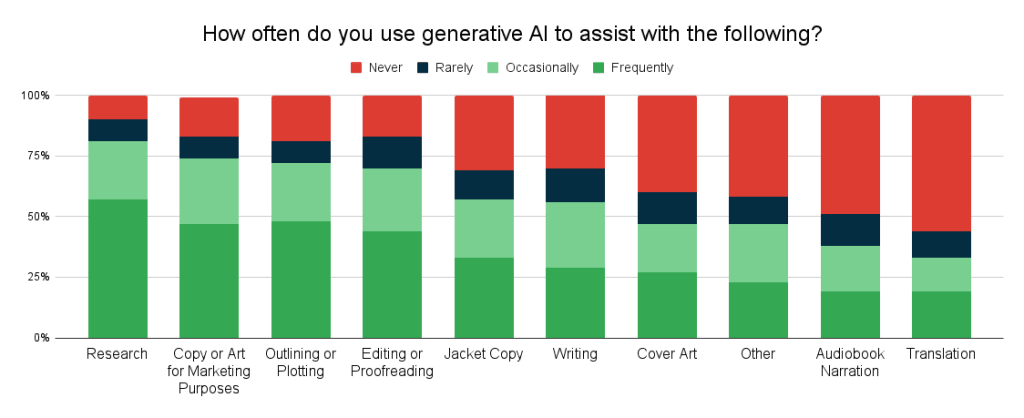
But here’s where the report gets really interesting: “74% of the authors who use generative AI do not disclose their AI use to readers.”
Catch that? Essentially one out of three authors out there right now are quietly using AI and going about their day—with none the wiser.
As one respondent put it: “Honestly it’s no one’s business if I use AI. The stories are all me. I’m the director. I’m the storyteller. These language models don’t give great output if you don’t already know your craft. Just like many authors don’t disclose a ghostwriter.”
(Want to take a wild guess how many “prolific” indie authors use ghostwriters under NDA or don’t meaningfully contribute to their “co-authored” novels? It’s a whole lot more than you think—but that’s a different article for another day…)
Meanwhile, while anti-AI activists organize Twitter campaigns and threaten boycotts, that invisible third of the market is operating successfully. And if AI-generated marketing materials actually tanked sales the way critics claim, this would be economic suicide.
Authors track metrics obsessively. Click-through rates, conversion rates, Amazon rankings, BookBub acceptance. If those 33% using AI in secret were hemorrhaging sales, they’d stop or go out of business.
Instead, adoption is accelerating.
Among AI users, 75% use it for marketing copy or art—everything from cover designs to Facebook ad images to promotional graphics. About half use it specifically for cover art. That’s roughly one in three authors in the survey producing marketing materials with AI that readers see every day, and three-quarters of them aren’t telling anyone.
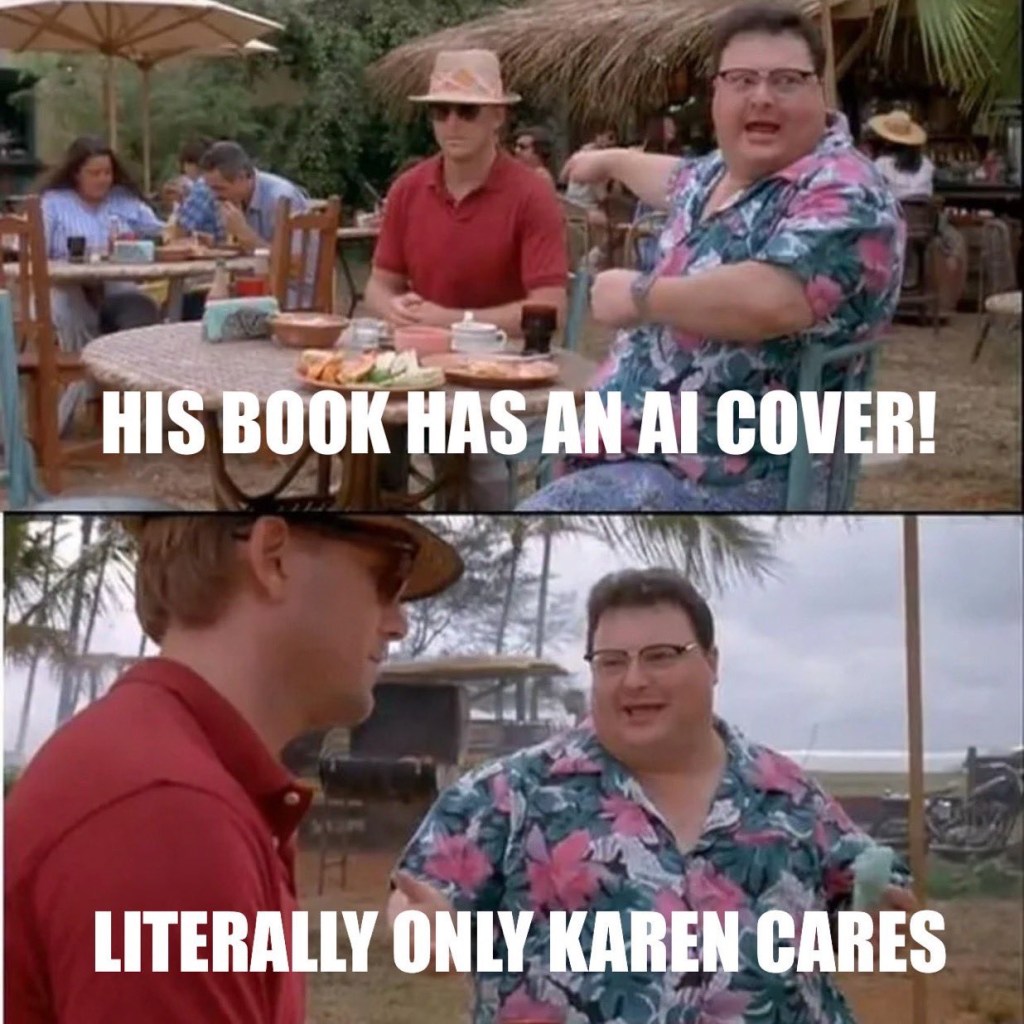
Critics claim “I can always tell AI art.” They point to anatomical errors, weird hands, glossy oversaturation, typography disasters.
They’re right—about the AI art they can identify.
They’re blind to their false negatives. They can only see two categories of AI: bad (obvious tells) and disclosed (someone admitted it). That invisible 33%? The ones producing professional-looking marketing materials readers actually click on? Critics can’t see them.
It’s like studying only failed businesses and concluding entrepreneurship doesn’t work—while ignoring thousands of successful companies you never noticed.
The 2023 Self-Published Fantasy Blog-Off cover contest proves this perfectly.
Sean Mauss’s cover for Bob the Wizard won the reader popularity vote. Stylish guy in sunglasses, smoke curling from his mouth, ominous skies. Exactly the kind of cover that sells fantasy novels (can confirm: I bought the book because the cover was dope af).
Twitter artists immediately flagged it as AI-generated. Contest organizer Mark Lawrence asked for proof. Mauss provided preliminary sketches, progress photos, multi-layered Photoshop file showing his “process.”
Lawrence showed this evidence to 2,500 members of the SPFBO Facebook group. People who read fantasy voraciously. Judge books by their covers daily. Now specifically scrutinizing for AI characteristics.
The verdict? Not one person said they were sure it was AI generated.
Only when professional artists did forensic analysis—finding Mauss’s Midjourney username in metadata, matching generated images in archives—did the truth come out. The cover was collaged AI outputs.
What matters is the cover won a popularity contest before anyone knew its origin. The aesthetics worked. The execution was professional. Readers responded positively.
The backlash only came after disclosure.
Authors who disclose AI use fear Goodreads review-bombing, BookTok boycott threats, Twitter pile-ons, and the completely bogus and intellectually dishonest claim it’s proof their entire book is AI-written.
Authors who don’t disclose face nothing. Because your average reader shopping for books can’t tell and frankly DGAF.
The 74% aren’t hiding because AI marketing fails. They’re hiding because a vocal minority threatens to punish methodology while the market rewards results.
One BookBub survey respondent put it plainly: “I don’t disclose how the sausage is made because I don’t think it’s helpful for readers to know which craft books I’ve read, whether I use a hard copy of the Chicago Manual of Style or a grammar-checking app, whether I use a writers’ critique group or AI to bounce story ideas off of, or which editors and proofreaders I use.”
Tools are tools. Readers want good books with professional marketing. They don’t care how the sausage is made, only whether it’s delicious.
Major publishers like Tor no doubt still use AI despite controversies (it makes business sense). Indie author AI adoption stands at 45% and shows no signs of slowing—despite the ethical controversy (which we can debate elsewhere, preferably not in my comments). The 33% operating in secret are successful enough to keep doing it. Zero organized boycotts have materialized with measurable sales impact.
This isn’t a debate anymore. It’s one side performing outrage while the other makes money.
You can’t boycott what you can’t identify. You can’t prove sales harm when successful users are invisible. You can’t claim “I can always tell” when 2,500 fantasy readers demonstrably couldn’t.
I use AI, obviously—I write and post about it extensively, both what it does well and where it fails spectacularly. I’ve spent years testing it for beta reading, editing, developmental feedback, concept art, cover art, and just about every other creative task I could think of.
Many of those experiments ended in disaster. Some things generative AI and LLMs are horrible at. Other things they excel at. I’m a huge believer of using the best tool for the job. And I love to share my wins and failures with people so they can learn how to be more productive and cost-effective too.
So, yeah, I’m very transparent about where and how I leverage AI creatively, but not because I think I’m morally superior to the 74% who keep their use of AI under wraps. I understand exactly why they stay quiet. The fear of review-bombing or BookTok pile-ons. The Pavlovian braindead assumption that if you used AI for a cover, you must have AI-written the entire book.
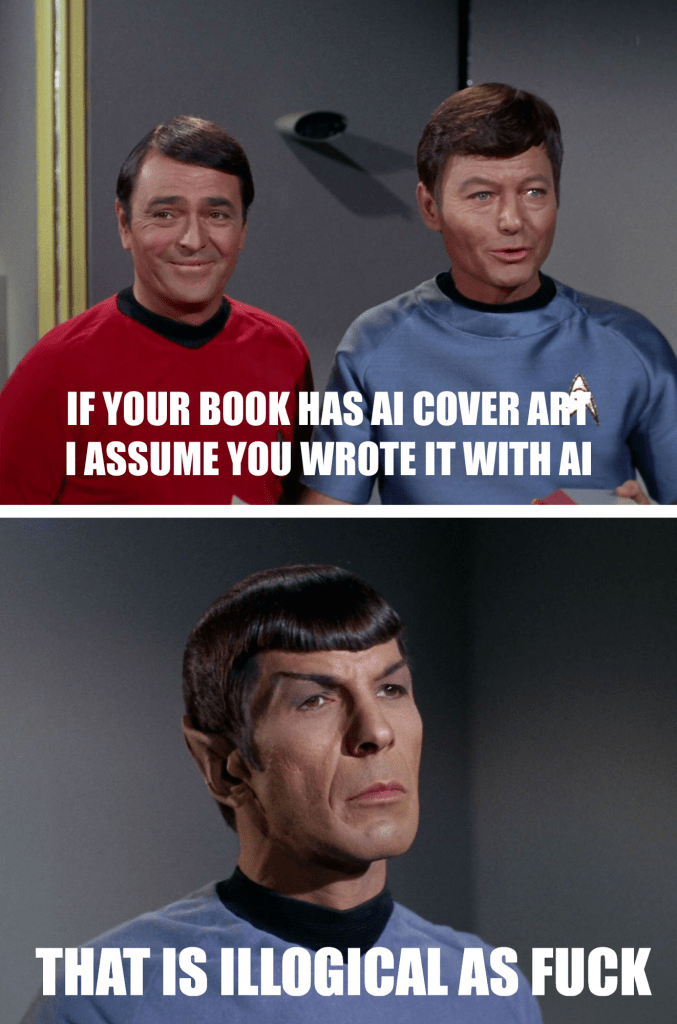
While my publicized use and advocacy of the technology could theoretically, potentially, hurt my own books’ sales, it hasn’t happened yet, and there’s no evidence of massed boycotts or review-bombing against myself or literally anyone else, so I’m not exactly sweating it.
(Well… there was that ONE case of review-bombing—Tor’s Fractal Noise—but it didn’t amount to much long-term and got push-back.)
All the bold threats from the small but vocal anti-AI crowd are a tempest in a teapot—or as Shakespeare so eloquently put it:
It is a tale told by an idiot, full of sound and fury, signifying nothing.
Macbeth. Act 5, Scene 5
The really ironic part is everyone is already using AI whether they know it or not (Grammarly, Google Docs, Office, Adobe, Spotify, etc. all use AI under the hood).
In 3-5 years the technology will be ubiquitous, the ethics long settled, and we can all have a good chuckle reminiscing over the Luddites who mewled about “slop” as we break new creative ground with the amazing tools at our disposal.
Discover more from Beyond the Margins
Subscribe to get the latest posts sent to your email.

 Beyond the Margins
Hey Ryan,
Great Article, thanks for writing this,
I made a response over on my blog here. Hope you don’t hate it.
A.B. Timothy, Author
LikeLike
Thanks for the thoughtful reply. I too couldn’t fit my response in a comment, so I posted it here: https://ryanwilliamson.com/2025/11/02/ai-isnt-the-problem-fraudulent-authorship-is/
LikeLike