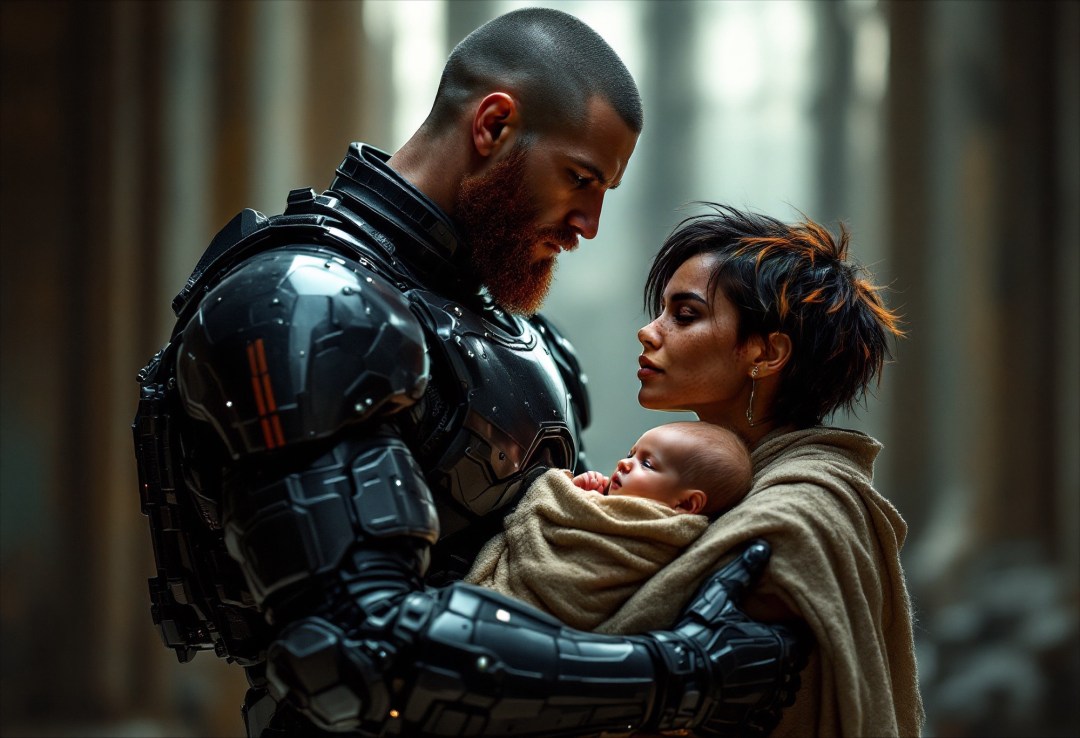
Mikhael is six-foot-six, 265 pounds of engineered lethality—a former elite assassin who can teleport through space in combat and control fire, who heals broken bones in minutes, whose body count exceeds two hundred confirmed kills.
He was designed to be the Dominion’s perfect weapon: an Immortal, one of the “demon-possessed” super-soldiers who enforce the will of The Name, the immortal god-emperor who has ruled the galaxy for three thousand years.
The Dominion sent him to kill another rogue operative, a sister Immortal. Her identity? Classified.
He chooses to save her instead.
Military science fiction is full of super-soldiers—genetically enhanced killers with impossible abilities who follow orders without question until the plot requires them to go rogue. They’re competent, deadly, and about as emotionally complex as their weapons. Mikhael fits that profile on paper: psionic powers, bio-engineering, trained from childhood to be the Dominion’s perfect weapon. But the thing that sets him apart isn’t his body count or his combat abilities—it’s what he does with all that lethality once he makes his choice. Most rogue operators in military SF become lone wolves, using their skills to fight the system that made them. Mikhael uses his to create space for someone else to heal. He doesn’t reject being a weapon because he’s discovered a higher calling or a righteous cause—he rejects it because the woman he loves needs someone who can be gentle, and he’s willing to learn how even though nothing in his training prepared him for it.
That choice is where Immortal begins—not with explosions or space battles (though there are plenty of those), but with a man deciding that the woman he never stopped loving matters more than the empire that made him, more than his orders, more than his own soul. It’s a choice that marks him as apostate, a traitor to his own god, that puts a termination order on his head with instructions to kill him with extreme prejudice, that costs him everything he was raised to be. And he makes it instantly, the moment he finds her in the desert and recognizes his target as the girl he grew up with and still loves.
The devastating part is that Sarai doesn’t remember him. She doesn’t remember anything before waking up in a medical tent surrounded by strangers. She was scheduled for termination because of the pregnancy—shot in the head and left for dead in the wasteland. The nanoculture in her bloodstream kept her alive, slowly rebuilding her destroyed brain tissue, but the damage to her hippocampus and memory centers was catastrophic. Her memories are fragments, shattered pieces that don’t connect into anything coherent. The man who teleports into a firefight to rescue her, who risks everything to protect her, is functionally a stranger wearing a vaguely familiar face.
“The child you carry is worse than unthinkable.” Mikhael rubbed his face. “It’s unholy. It’s blasphemous.”
Sarai izt Kviokhi is the Sword and Chalice of prophecy, the woman foretold to end The Name’s reign. She’s also pregnant with his child—and this isn’t just dangerous or scandalous. It’s biologically and theologically impossible. The Name—the Incarnation, Our Eternal Father—has children. Hundreds of Scion heirs, pure and spotless, born of his divine unions with his own Scion daughters. But an Anathema woman bearing his child? The cursed, the marked, the inferior races who exist to serve their Scion masters? The entire foundation of the Dominion rests on this truth: Scions are divinely pure, Anathema are fundamentally lesser. Cursed. Marked. The hierarchy is written into genetics, into theology, into three thousand years of imperial doctrine.
Sarai’s pregnancy shatters that lie.
To the Dominion, it’s a scandal that must be erased before anyone learns it existed. To the oppressed across the galaxy, it’s a sign—proof that the hierarchy is crumbling, that prophecy is unfolding, that hope might not be dead after all. Sarai’s pregnancy is revolution made flesh. It’s also a death sentence for her and the child both.
Whether being sent to kill the woman he loves was a bureaucratic mixup or a divine test of his loyalty, Mikhael will never know. All he knows is he lost her once because he wasn’t patient enough to wait for her, and he refuses to lose her again. Mikhael and Sarai grew up together in the Immortal Academy, trained together from childhood, were close once before his impatience drove them apart. The details are lost to Sarai’s fragmented memory, painful even in Mikhael’s. Years passed after “something happened” between them. He tried to move on from her. He never managed to.
“I never stopped loving you,” he tells her when he finds her again. “I don’t know how to not love you.” When he learned what The Name had done to her, the choice was instantaneous. He went rogue, became a traitor, marked himself for execution by every Immortal in the galaxy. For her. Later, when Sarai’s captured and he’s asked what he’s willing to sacrifice to get her back, his answer is immediate: “Anything.” He’d already sacrificed his soul for her, if he still believed in that. In truth, he didn’t know what he believed in anymore—except for her. Sarai was his religion now.
“I can’t give you this.” Sarai motioned to her body. “I’m broken. He broke me. What I wanted for us has been ruined for me.”
Rescuing someone and healing them are different wars entirely, and I think this is where Mikhael becomes something more than just a competent soldier who went rogue for love. The Mikhael who fights is terrifying—blinking through space mid-combat, appearing behind enemies from nowhere, summoning fire, bones knitting as fast as they break, brutal and efficient and unstoppable. He’s a weapon doing what weapons do. The Mikhael who loves is something else entirely: patient, gentle, waiting. And the waiting costs him something, because they’re being hunted and time is the one resource they don’t have, and every day he spends not pushing her is a day that might be their last.
Sarai is pregnant with her rapist’s child, her body no longer entirely her own. The Name didn’t just violate her physically—he invaded her mind, turned her into a puppet while she watched helplessly from a distance as her own body betrayed her. She was forced to watch herself respond to him, forced to feel her body’s reactions while her mind screamed in horror. The thought of physical intimacy now terrifies her, makes her nauseous, turns her stomach into knots. She wants to want Mikhael—the fragments of memory tell her she loved him once, should love him now—but trauma doesn’t care what you should feel.
“I can’t give you this,” she tells him, motioning to her body. “I’m broken. He broke me. The thought of physical intimacy is terrifying and revolting. What I wanted for us has been ruined for me.”
What she doesn’t remember is that she wasn’t ready before, either. That Mikhael had been impatient then, and that impatience cost them everything. Now, facing her again—broken by his god’s violence, carrying proof of that violation—he finally learns the lesson he should have learned years ago.
Another man might pressure her, might sulk and measure his worth by what she can’t give him yet, might make her feel guilty for not being ready when they might not have tomorrow. Mikhael doesn’t do any of that.
“Let me try,” he says. “Let me try to make you love me again.”
Not: let me take what I’m owed. Not: you should be ready by now. Not: we don’t have time for this. Just: let me try. Let me earn it. Let me prove I’m safe. And when Sarai finally comes to him—in the middle of the night, wrapped in fear and determination, needing to try even though she’s terrified—and tells him “don’t touch me,” he listens. When she freezes, trembling with echoes of violation, he stops. “Take as much time as you need,” he tells her. “If you have to stop, we stop. I won’t be upset.”
“You’re trembling,” she whispers, feeling his hands shake.
“I’m scared too,” he admits. “That this is a dream.”

This is what makes Immortal work for me as more than just space opera with super-soldiers and prophecy. It’s a weapon learning to be gentle. A man learning from his mistakes. A survivor learning to trust again. Two people stealing moments of intimacy from a universe that wants them dead, building something fragile and fierce in the wasteland. The space battles and teleporting assassins and galaxy-spanning conspiracy are all there, but the emotional core is this: a man who was engineered to kill, who failed the woman he loved once through selfishness, learning how to love someone who’s been shattered—and doing it without demanding she put herself back together on his timeline.
“I love you. All of you. And she’s part of you,” Mikhael said, looking at the impossibly small girl. “I’ll love her as if she were our own.”
When Sarai gives birth—in a crumbling safe house while being hunted, with only a nomadic outcast girl named Lenaja to help—Mikhael is there. The infant is impossibly small, premature, what Sarai half-jokingly calls a “feisty little abomination” through her exhaustion. Her beautiful blasphemy. She’s the daughter of the Incarnation, proof of the impossible, the reason half the galaxy wants them dead and the other half wants to own her. She’s a sign the Bane of the False God has come, the only concrete evidence that the Dominion’s entire theological foundation is a lie, which makes her the most dangerous child in the galaxy.
“She’ll need a father,” Sarai says, watching Mikhael look at the tiny girl. “She’ll need to be yours.”
Mikhael looks at the infant—daughter of the monster they’re running from, proof of Sarai’s violation, the child of a god who broke the woman he loves. He could resent her. He could see The Name every time he looks at her face. He could love Sarai while keeping the child at arm’s length, doing his duty to protect her but never really accepting her.
“I love you,” he tells Sarai, “and I’ll love her as if she were our own. I’d be proud to have her call me her father.”
Sarai names her Mikhalah. A feminine form of his name in the tradition of his people.
This is what I think makes Mikhael extraordinary in the landscape of military science fiction—he doesn’t just fight for Sarai, doesn’t just protect her from external threats. He creates space for her to heal. He becomes the father to a child that isn’t his biologically but absolutely is his in every way that matters. He holds Sarai when she weeps, gives her time when she needs distance, and never uses his patience as leverage or a weapon. He doesn’t count the days she’s not ready and throw them in her face. He doesn’t make her daughter’s existence about him and what it costs him. He just loves them both, completely, without demanding they earn it or prove they’re worth the sacrifice.
“Immortals don’t form attachments. They don’t fall in love. There are no happy endings for our kind,” Sarai whispered.
Mikhael stepped toward her and reached out, hesitated, and then cupped the back of her head, lifting her face to his. “We’re just two people now, Sarai. Let me try.”
The tenderness exists in the context of extraordinary violence. Mikhael is being hunted by kill teams of his former brothers and sisters, elite Immortals with orders to terminate him with extreme prejudice. Every moment of peace is stolen. Every day together might be their last. He coordinates tactical defenses while Sarai nurses their daughter, teleports through firefights to buy her minutes of safety, makes impossible choices about who to save and who to sacrifice and how much blood to spill to protect the woman who’s supposed to save the galaxy.
“We don’t know how much time we have,” Sarai tells him one night when the fear of lost chances becomes bigger than the fear of intimacy. “Tonight, right now, could be our only chance to be together.”
She’s right. In a story about prophecy and religious tyranny and galactic revolution, time is the cruelest enemy—not The Name with his god-like powers, not the Dominion’s vast military machine, but the simple brutal fact that two people in love might not get a tomorrow. They might not even get through tonight. So they steal today. They build a family in the ruins. They fight, they heal, they love as fiercely as the galaxy allows, knowing that any moment could be the last one, that every touch might be goodbye.
“We don’t know how much time we have. Tonight, right now, could be our only chance to be together… I want to be with you. I want to try, at least.”
Mikhael looked confused as she unbelted her robe.
“What are we doing?” he asked.
“Conquering fear.”
Military science fiction often treats romance as optional seasoning, something you sprinkle on top of the real plot to appeal to a broader audience. Immortalmakes love central—not as a distraction from the space battles and prophecy, but as the axis everything turns on. Mikhael’s defection isn’t just politically significant (though it is—Immortals don’t go rogue, don’t choose conscience over orders, don’t betray the only family they’ve ever known). It’s personally transformative. He was engineered to be a weapon, raised to serve The Name and the Dominion, conditioned to kill without question. He chose a different faith instead: Sarai became his religion. He’s a lover. A father. A patient protector who measures success not in kills but in moments of peace he can give the woman he loves.
He doesn’t fight for the cause, revenge, or glory. He fights for a family he was told he could never have.

This is what I think Dark Dominion does well as space opera—it takes the familiar tropes of the super-soldier and the chosen one and the evil empire and asks what they cost. What it means to be a strategic weapon learning to be human. What healing looks like when the wound is carved by a god. How love functions not as salvation or cure but as daily choice, made over and over in the face of impossible odds. Mikhael embodies that choice every time he refuses to be what the Dominion made him, every time he waits for Sarai’s consent, every time he holds baby Mikhalah and promises to protect her from the Incarnation who fathered her.
In the wasteland of galactic tyranny, gentleness becomes the most radical act of all.
And Mikhael—a monstrosity of engineered death who chose love over orders—is the gentle giant at the heart of a revolution he doesn’t give a shit about.
He just wants to keep Sarai alive long enough to have breakfast together.
Discover more from Beyond the Margins
Subscribe to get the latest posts sent to your email.

 Beyond the Margins
One thought on “Love in the Wasteland: Mikhael and the Art of Gentle Defiance”