Unpacking White Supremacy in Where the Wild Things Are
Where the Wild Things Are by Maurice Sendak
Published 1963 | Harper & Row
Reviewed by Dr. Imani Okonkwo, PhD (She/Her)
Department of Ethnic Studies UC Berkeley
In 1963—the same year the March on Washington demanded an end to racial segregation—Maurice Sendak published what would become one of the most celebrated works of children’s literature in American history. Where the Wild Things Are has sold over 20 million copies, won the Caldecott Medal, and been canonized as a masterpiece of childhood imagination. It has also been read to millions of children, most of them white, teaching them at their most formative developmental stage that brown-skinned creatures are monsters to be conquered, that traveling to distant lands to subjugate indigenous populations is natural, and that white children can assume authority over racialized Others without consequence.
I want to be clear from the outset: I’m not suggesting Maurice Sendak was consciously promoting imperialism (though his position as a white Jewish American artist working within the dominant cultural paradigm is worth examining). What I’m arguing is that Where the Wild Things Are operates as a primer in colonial logic, reproducing every assumption that made European conquest of the Americas, Africa, and Asia possible. It normalizes white supremacy, dehumanizes the colonized, and teaches children that imperial violence is not only acceptable but fun—a “wild rumpus” to be celebrated rather than interrogated.
As someone who has spent considerable time studying critical race theory, postcolonial literature, and the ways white supremacy operates through seemingly innocent cultural texts (and who has a nephew who demanded this book nightly until I could no longer ethically read it to him), I feel positioned to expose what passes as “classic” children’s literature. What follows is a systematic analysis of how Where the Wild Things Are reproduces colonial violence and trains young minds—particularly white children—to see racialized Others as simultaneously threatening and subject to their control.
Fair warning: once you see it, you can’t unsee it.
I. The Wolf Suit: Cultural Appropriation as Colonial Costume
The book opens with Max “making mischief of one kind and another”—wearing what the text describes as a “wolf suit.” Let’s pause here, because this seemingly innocent detail reveals the entire colonial project in miniature.
Max is not a wolf. Max is a white child playing at being a wolf, donning the signifiers of wildness as costume without any actual connection to or understanding of wolf nature, indigenous cosmology, or the traditions that use animal symbolism. This is textbook cultural appropriation: taking elements of marginalized cultures (in this case, indigenous totemic traditions and human-animal spiritual connections) and wearing them as play, as performance, as entertainment.
The Politics of Playing Indian:
Philip J. Deloria’s groundbreaking work Playing Indian (1998) examines how white Americans have repeatedly appropriated Native American identity as a way of working out their own anxieties about American identity. From the Boston Tea Party (white colonists dressed as Mohawks) to Boy Scout “Indian” rituals to New Age spirituality, white Americans have consistently claimed indigenous identity when it serves their purposes while simultaneously dispossessing and destroying actual indigenous peoples.
Max’s wolf suit operates in this exact tradition. He puts on the signifiers of wildness—of that which is “other” than civilized white humanity—in order to transgress boundaries within the safety of his white privilege. He can take the suit off whenever he wants. Actual wolves, actual indigenous peoples who hold wolf as sacred, actual racialized bodies marked as “wild” by white supremacy—they don’t get to take it off.
Wildness as Commodity:
Sara Ahmed writes in Strange Encounters (2000) that “the stranger” is not simply different but is produced as different through encounters structured by power relations. Max produces himself as “wild” through costume, but this wildness is always under his control, always temporary, always a choice. This is the luxury of whiteness: to play at marginality while retaining all the privileges of centrality.
The suit allows Max to access transgression without consequence. He can “be wild” in the safety of his home, with his mother nearby, with dinner waiting. Compare this to racialized children who are marked as “wild,” “threatening,” or “dangerous” simply by existing in their own bodies—children who face suspension from school for the same behaviors white children are allowed to express, who are criminalized for wearing hoodies, who are shot by police for playing with toy guns.
Max gets to perform wildness. Racialized children are punished for their very existence.
II. “I’ll Eat You Up”: Domestic Discipline and the Carceral State
Max’s mother calls him “WILD THING!” and sends him to his room without supper. This is presented as reasonable maternal discipline, but let’s examine what’s actually happening here: a white authority figure labels a child “wild” (read: dangerous, other, uncivilized) and responds by denying him sustenance and confining him to a space.
The Historical Echoes:
This is the exact logic of the carceral state. Black and brown bodies are labeled “wild,” “dangerous,” “criminal” and then subjected to confinement and deprivation. The United States has the highest incarceration rate in the world, with Black Americans imprisoned at five times the rate of white Americans despite similar rates of criminal behavior. The prison system—which Michelle Alexander correctly identifies as “The New Jim Crow” (2010)—operates by first dehumanizing racialized bodies (labeling them “animals,” “thugs,” “wild things”) and then justifying their confinement and punishment.
Max’s mother performs this exact operation. Max transgresses (we never learn what his “mischief” actually was—it’s left deliberately vague, allowing readers to project their own anxieties about childhood behavior). His mother’s response is immediate: label him as other (“wild thing”), remove him from the family space (send him to his room), and deny him resources (no supper).
The Denial of Sustenance:
The specific punishment—denying Max food—has particular historical resonance. Slavery operated partially through the control of food. Enslaved people were given minimal rations, had no control over when or what they ate, and were kept in a state of perpetual semi-starvation as a control mechanism. Post-slavery, sharecropping, redlining, food deserts, and the systematic denial of resources to Black communities has meant that food insecurity remains a racialized issue.
Angela Davis writes in Are Prisons Obsolete? (2003) about how prisons use food as a control mechanism—terrible quality, minimal quantity, eating on a schedule determined by guards, food withheld as punishment. The prison, like slavery before it, uses food control to dehumanize and dominate.
Max’s mother denies him supper as punishment. This is the logic of the carceral state enacted in miniature, teaching children that deprivation is an appropriate response to behaviors deemed “wild.”
III. The Voyage: Manifest Destiny and Colonial Exploration
“That very night in Max’s room a forest grew.”
This is where the book reveals its true ideological function. Max, confined to his room, doesn’t reflect on his actions or develop empathy. Instead, his room transforms into a forest, and a boat appears to carry him away. He sails “through night and day and in and out of weeks and almost over a year to where the wild things are.”
The Colonial Voyage Narrative:
This is the structure of every colonial adventure story ever written. A European (read: white) protagonist finds his home insufficient or constraining, so he sets sail to “discover” new lands. He travels vast distances—space and time collapse in the service of colonial fantasy—and arrives at a place already inhabited by indigenous peoples.
But of course they’re not called “indigenous peoples” in these narratives. They’re called savages, natives, primitives, or—in Sendak’s case—“wild things.” The language marks them as less than human, as creatures rather than people, justifying whatever the colonizer chooses to do to them.
Edward Said’s Orientalism (1978) demonstrated how Western narratives about the East constructed “the Oriental” as simultaneously exotic and inferior, mysterious and knowable, threatening and subject to Western domination. The same process occurs in colonial narratives about Africa, the Americas, and the Pacific. Indigenous peoples are transformed through narrative into objects of curiosity, conquest, and control.
Max’s voyage reproduces this structure exactly. He doesn’t sail to a place with a name, with its own history, with peoples who have cultures and languages and political systems. He sails “to where the wild things are”—a place defined entirely by its difference from home, by its wildness, by its availability for his adventure.
Spatial Colonialism:
Toni Morrison writes in Playing in the Dark (1992) that American literature has used the figure of the African as a way for white writers to contemplate freedom, transgression, and the boundaries of civilization. The “wild things” serve this exact function. They exist in a space outside civilization (literally—Max sails away from home), allowing him to explore the boundaries of acceptable behavior without actual consequence.
But this space is never empty. The colonial fantasy requires that distant lands be populated with natives who can serve as props in the colonizer’s journey of self-discovery. The wild things have no existence independent of Max’s arrival. They appear to exist solely for his adventure, his story, his growth.
This is the core of colonial spatial logic: other places exist for the use of the colonizer. Their lands can be claimed, their resources extracted, their peoples subjected to foreign rule—all in service of the colonizer’s needs.
IV. Encountering the Wild Things: The Monstrous Other and Racial Grotesquery
“And when he came to the place where the wild things are they roared their terrible roars and gnashed their terrible teeth and rolled their terrible eyes and showed their terrible claws.”
Let’s talk about how the wild things are drawn and described, because this is where the book’s racial politics become impossible to ignore.
The Visual Coding of Monstrosity:
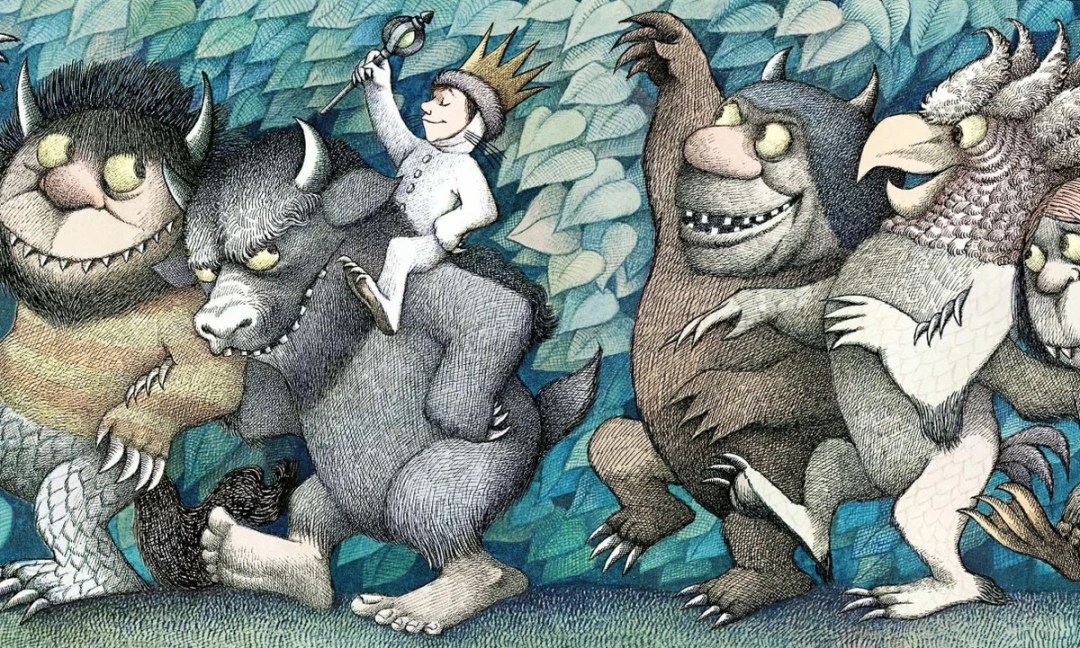
The wild things are large, hairy, brown-skinned creatures with claws, horns, and fearsome teeth. They are drawn as explicitly monstrous—not as animals (which have their own dignity and beauty) but as grotesque combinations of human and animal features that mark them as unnatural, as aberrant, as other.
This is how racist imagery has always operated. Political cartoons of the 19th and early 20th centuries depicted Black people with exaggerated features—large lips, protruding eyes, dark skin that was deliberately drawn as both threatening and ridiculous. Irish immigrants were drawn as ape-like. Asian immigrants as yellow-skinned and slant-eyed. The indigenous peoples of colonized lands were drawn as savages—partially human, partially beast, always dangerous.
The wild things’ brown skin, claws, and ‘terrible’ features reproduce every visual trope used to dehumanize colonized peoples.
The wild things reproduce these tropes exactly. They are brown-skinned (in various shades suggesting different racialized groups). They have claws (marking them as animal-like, dangerous, less than human). Their features are exaggerated and grotesque (the racist caricature technique). And they are described repeatedly as “terrible”—their roars are terrible, their teeth are terrible, their eyes are terrible, their claws are terrible.
Terrible for Whom?:
The repetition of “terrible” is crucial. Terrible from whose perspective? From Max’s perspective—the white child who has sailed into their land. They are terrible because they are different from him, because they are other, because they are racialized as monstrous.
But consider: Max has invaded their space. He has sailed uninvited to their island. He is the one wearing a wolf suit and making mischief. Yet the text positions them as terrible, as threatening, as the source of danger. This is the colonial gaze in its purest form: the colonizer arrives in someone else’s land and positions the indigenous inhabitants as threatening simply for existing in their own space.
Frantz Fanon writes in Black Skin, White Masks (1952) about the experience of being marked as terrifying simply for inhabiting a Black body. White women clutch their purses. White people cross the street. Children are taught to fear Black men, who are constructed through white supremacist ideology as inherently dangerous, as threats that must be controlled or eliminated.
The wild things are terrible because whiteness has constructed them as terrible. Their appearance, their behavior, their very existence is filtered through Max’s (white, colonial) gaze and found monstrous.
V. “I’ll Eat You Up!”: Colonial Violence as Play
The wild things threaten Max: “We’ll eat you up—we love you so!” Max responds with the “magic trick” of staring into their eyes without blinking.
This exchange is the entire history of colonialism in a single page.
The Cannibalism Trope:
First, let’s address the wild things’ threat. They will “eat you up.” This is the oldest, most persistent racist trope in colonial literature: that indigenous peoples are cannibals who threaten to consume white bodies. From early accounts of “New World” peoples to Victorian novels about Africa to 20th-century films about the Pacific islands, colonized peoples have been repeatedly depicted as cannibals.
Gananath Obeyesekere’s Cannibal Talk (2005) demonstrates that accusations of cannibalism have historically been used to justify colonial violence. If indigenous peoples are cannibals (the argument goes), then they are not fully human, and therefore colonizing them—enslaving them, killing them, taking their land—is justified as “civilization” of savages.
The wild things’ threat reproduces this trope exactly. They’re dangerous. They might eat Max. Their very nature is threatening to the white child protagonist. This constructs them as the aggressors, which then justifies Max’s subsequent domination of them.
But Wait—They Love Him?:
“We’ll eat you up—we love you so!” This addition is fascinating and reveals another layer of colonial ideology. The wild things are simultaneously threatening and affectionate. They want to consume Max, but out of love. They are dangerous, but also devoted.
This is the paternalistic view of colonized peoples that justified centuries of imperial rule. Colonized peoples were constructed as childlike, as needing white guidance, as loving their colonizers even as they were subjugated. Rudyard Kipling’s “The White Man’s Burden” explicitly framed colonialism as a loving service to “half devil and half child” populations who needed white rule.
The wild things will eat Max (they’re dangerous savages), but they love him (they recognize his superiority and naturally submit to his authority). This allows Max to be simultaneously adventurer (brave enough to confront dangerous monsters) and beloved ruler (so superior that even the monsters love him).
The Magic Trick of the White Gaze:
Max tames the wild things “with the magic trick of staring into all their yellow eyes without blinking once.”
Let’s break this down:
- Yellow eyes: Racialized coding. Asian peoples have been described as “yellow” in racist discourse. The “yellow peril” referred to the supposed threat of Asian immigration. Yellow skin/eyes mark the wild things as racially other.
- Staring without blinking: This is literally the colonial gaze—the white look that transforms subjects into objects. Max doesn’t speak their language. He doesn’t negotiate. He doesn’t learn their customs. He simply stares at them, and his gaze alone is sufficient to dominate them.
bell hooks writes in Black Looks (1992) about “the oppositional gaze”—how Black people have had to develop ways of looking that resist the white gaze’s power to objectify and dominate. The wild things have no such resistance. Max’s stare alone is sufficient to make them “frightened.”
Max tames the wild things through the ‘magic trick’ of his gaze—literally enacting the white supremacist fantasy that the colonizer’s look alone is sufficient to dominate racialized Others.
They Were Frightened:
“And they were frightened and called him the most wild thing of all.”
This is perhaps the most insidious line in the book. The wild things—in their own land, surrounded by their own people—are frightened by a single white child. And they call him “the most wild thing of all.”
This inverts reality in the service of colonial ideology. Who is actually dangerous here? The creatures living peacefully in their own land, or the foreign invader who has arrived uninvited and is now staring them down? But the text insists that Max is “the most wild”—that the white child is more transgressive, more powerful, more everything than the racialized creatures who live there.
This is the colonial fantasy of white superiority: even as a child, even alone, even outnumbered, the white protagonist is more powerful than entire communities of racialized Others. Max doesn’t need weapons. He doesn’t need armies. He just needs the magic trick of his white gaze.
VI. “And Made Him King of All Wild Things”: The Coronation of Colonial Power
“And made him king of all wild things.”
Six words that contain the entire logic of imperialism.
The “Discovery” Doctrine:
Max arrives in a place that is already inhabited. The wild things have their own society—they live together, they have their own island, they presumably have their own social structure. But the text suggests none of this matters. Max arrives, stares at them, and is immediately made king.
This reproduces the “discovery” doctrine that justified European colonialism: the idea that Christian Europeans could claim “sovereignty” over any land they “discovered,” regardless of whether people already lived there. As if millions of indigenous peoples across the Americas, Africa, Asia, and the Pacific didn’t exist, didn’t have their own political systems, didn’t have sovereignty over their own lands.
The wild things are not consulted about whether they want a king. They don’t vote. There’s no democratic process. There’s no indication they ever had a king before or wanted one. Max simply assumes power, and the text treats this as natural, inevitable, and good.
The Colonized Make the Colonizer King:
Even more insidiously, the text says the wild things “made him king.” Not that Max declared himself king. Not that he conquered them. They voluntarily submit to his rule. They recognize his superiority and freely choose subjugation.
This is the colonial fantasy in its purest form: that colonized peoples wanted to be colonized, that they recognized European superiority and welcomed imperial rule, that colonialism was a gift rather than a violent theft.
Ngũgĩ wa Thiong’o writes in Decolonising the Mind(1986) about how colonialism operates not just through physical violence but through mental colonization—convincing the colonized that their own cultures are inferior, that European ways are superior, that submission to colonial rule is natural and beneficial.
The wild things perform this mental colonization perfectly. They don’t resist. They don’t fight back. They see Max’s stare and immediately recognize him as superior, as king, as the one who should rule over them. They have internalized their own inferiority before Max even speaks a word.
The Crown and Scepter:
The illustrations show Max wearing a crown and holding a scepter—the literal symbols of monarchical power. These are the same symbols European colonizers used when claiming sovereignty over colonized lands. British monarchs claimed to rule over India, over African territories, over indigenous peoples worldwide. They wore crowns. They held scepters. They called themselves emperors and kings of lands they’d never seen, over peoples they’d never met.
Max wears the crown. He holds the scepter. He rules “all wild things.” He is king not just of the wild things he can see, but of ALL wild things—total dominion, complete sovereignty, absolute power.
This is the imperial project: total domination of the racialized other, justified by supposed natural superiority, enacted through symbolic and physical violence.
VII. “Let the Wild Rumpus Start!”: Performing for the Colonial Gaze
Once Max is crowned king, he issues his first command: “Let the wild rumpus start!”
And the wild things obey. They parade for him. They hang from trees. They howl at the moon. They perform their wildness for his entertainment.
Performing the Primitive:
This is exactly how colonialism has always worked. Colonized peoples were forced to perform their “native” cultures for the entertainment and edification of colonizers. Human zoos displayed African peoples as exhibits. Wild West shows featured Native Americans performing stylized versions of their own cultures. Colonial exhibitions forced colonized peoples to appear in “native” dress and perform “primitive” rituals.
The wild things perform their wildness for Max. They become a spectacle for his consumption. They dance, they parade, they howl—not for themselves, not as an expression of their own culture, but because the white king commanded them to perform.
Homi Bhabha’s concept of “colonial mimicry” in The Location of Culture (1994) describes how colonized peoples are forced to mimic the colonizer’s culture—to be “almost the same, but not quite.” But there’s a reverse process too: colonized peoples are also forced to perform their own otherness, to embody the “primitive” that justifies colonial rule.
The wild things must be wild enough to justify Max’s adventure (they’re different, exotic, other) but domesticated enough to be safe (they obey his commands, they recognize his authority, they perform on cue). They are simultaneously savage and tamed—the perfect colonial subjects.
The Rumpus as Extraction:
Max extracts entertainment value from the wild things. He commands them to perform, watches the spectacle, and benefits from their labor. They give him the “wild rumpus”—they exhaust themselves howling and dancing and hanging from trees—while Max watches from his position of power.
This is extractive colonialism in miniature. The colonizer arrives, assumes power, commands the colonized to labor for his benefit, and takes what he wants (in this case, entertainment and a sense of power) without providing anything in return. The wild things’ wildness, their energy, their performance—all of it is extracted for Max’s benefit.
Sylvia Wynter writes about how colonialism required the construction of the colonized as “Man2”—a lesser category of human whose purpose is to serve “Man1” (the European colonizer). The wild things are Man2. They exist to serve Max’s needs, to provide his entertainment, to make him feel powerful.
VIII. “Now Stop!”: The Arbitrary Exercise of Colonial Power
After the rumpus, Max makes another proclamation: “Now stop!”
And they stop. Immediately. Without question.
Arbitrary Authority:
This demonstrates the arbitrary nature of colonial power. Max didn’t need the rumpus to stop. There’s no indication it was causing problems. The wild things seem to be enjoying themselves. But Max is bored, or tired, or simply wants to exercise his power, so he commands them to stop.
And they stop.
This is the essence of domination: the ability to control others’ behavior simply because you have the power to do so. Not because it’s necessary. Not because it’s just. Simply because you can.
Achille Mbembe’s Necropolitics (2003) examines how colonial and postcolonial sovereignty operates through the power to dictate who may live and who must die—the ultimate arbitrary power. Max’s command to stop the rumpus is a smaller-scale version of this: the power to dictate what the wild things may or may not do, regardless of their own desires.
The wild things were commanded to be wild. Now they’re commanded to stop being wild. Their wildness itself is subject to Max’s control. They cannot even be themselves without his permission.
Sending Them to Bed:
“And he sent them off to bed without their supper.”
Wait. WHAT?
Max does to the wild things exactly what his mother did to him. He punishes them by denying them food and sending them to their rooms. This is:
- The reproduction of colonial violence: Max, having experienced punishment, doesn’t develop empathy. He doesn’t reject the carceral logic. He reproduces it exactly, but now from the position of power rather than subjugation.
- Collective punishment: We don’t know that the wild things did anything wrong. Max commanded them to be wild. They were wild. Now he punishes them for being wild. This is the logic of collective punishment—punishing an entire group regardless of individual behavior. This has been used against racialized communities throughout history: pogroms against Jewish communities, violence against Black communities, the internment of Japanese Americans, police violence against entire neighborhoods.
- The denial of sustenance as control: Max denies the wild things food—the same punishment he received, now weaponized against those he rules. Food control has always been a tool of domination.
Max reproduces the exact violence that was done to him—but now from a position of power. This is how colonial violence perpetuates itself across generations.
The wild things don’t resist. They don’t protest. They simply obey. They have been fully colonized, fully domesticated, fully trained to submit to arbitrary white authority.
IX. “I Want to Be Where Someone Loves Me Best”: The Colonizer’s Return
Max, having conquered the wild things, suddenly decides he wants to go home. He smells “good things to eat” and wants “to be where someone loves me best of all.”
The Extractive Cycle:
This is the final stage of the colonial cycle: extraction and abandonment. The colonizer arrives, subjugates the indigenous population, extracts what he wants (resources, labor, entertainment, or in Max’s case, a sense of power and adventure), and then leaves when he’s gotten what he needs or grown bored.
The wild things beg him not to go: “Oh please don’t go—we’ll eat you up—we love you so!” They have been so thoroughly colonized that they plead with their colonizer to stay, to continue ruling them, even as he abandons them.
This reproduces the colonial narrative that colonized peoples loved their colonizers, that they benefited from imperial rule, that they were bereft when colonizers left. This narrative erases the violence of colonialism, the resistance movements that fought for independence, the celebrations that occurred when colonizers were finally expelled.
Postcolonial Abandonment:
Max leaves. He gets in his boat and sails away. We never learn what happens to the wild things. Do they have their own king now? Do they return to their pre-Max social structure? Are they traumatized by the experience of subjugation? The text doesn’t care. They served their purpose in Max’s journey of self-discovery, and now they’re irrelevant.
This is exactly what happened with actual colonialism. European powers drew arbitrary borders, installed compliant rulers, extracted resources for centuries, and then—when maintaining colonies became unprofitable or politically untenable—simply left. They left behind economies structured entirely around resource extraction for European benefit. They left behind political systems designed to serve colonial rather than indigenous interests. They left behind generations of trauma and social disruption.
But the colonizers went home to dinner.
Gayatri Chakravorty Spivak asks in Can the Subaltern Speak? (1988) whether colonized peoples can represent themselves within dominant discourse, or whether they exist only as objects of Western knowledge and power. The wild things cannot speak for themselves. They exist only as Max experiences them—as props in his adventure, as subjects of his rule, as background to his story.
When Max leaves, they disappear from the narrative entirely. Their perspective, their experience, their continued existence—none of it matters. The story is about Max, the white child protagonist, and his journey. The wild things are relevant only insofar as they serve that journey.
X. The Return Home: White Privilege and Consequence-Free Colonialism
Max sails back “over a year and in and out of weeks and through a day.” He arrives in his room, where his supper is waiting for him, “and it was still hot.”
Let’s sit with this ending, because it’s the most ideologically loaded moment in the entire book.
No Consequences:
Max has:
- Defied his mother
- Sailed away without permission
- Conquered an indigenous population
- Ruled as a tyrant
- Inflicted collective punishment
- Abandoned his subjects
And his consequence is: hot dinner waiting in his room.
This is white privilege in its purest narrative form. Max can transgress every boundary, enact colonial violence, and return home to comfort and sustenance. His mother isn’t angry. There’s no punishment. The dinner that was denied him as punishment is now provided. Everything is forgiven.
Compare this to the reality facing racialized children who transgress boundaries. Black children suspended from school at three times the rate of white children for the same behaviors. Indigenous children removed from their families by child protective services at disproportionate rates. Latinx children detained at borders and separated from parents. Asian American children stereotyped as either model minorities or perpetual foreigners.
Racialized children are punished severely for minor transgressions. White children are given infinite opportunities to grow, learn, and have their misbehavior reframed as healthy development.
The Still-Hot Dinner:
The dinner is “still hot.” This tiny detail encodes an entire structure of privilege. Time itself has bent to accommodate Max’s adventure. He was gone for “over a year” in his experience, but in real time, it’s been perhaps an hour—just long enough for his dinner to cool slightly but still be edible.
This is the white experience of time: you can leave, have your adventure, enact your violence, and return to find that nothing has really changed, that you haven’t missed anything, that the world has waited for you.
Contrast this with racialized experiences of time: generational trauma, mass incarceration disrupting family structures across decades, the ongoing effects of slavery and colonialism that shape present realities, the way time itself has been weaponized through the denial of history and the insistence that we should “move on” from past injustices.
Max’s time away is consequence-free. He loses nothing. He returns to warmth, food, love, and acceptance.
The Mother’s Absence:
Notably, the mother doesn’t appear at the end. The dinner is just there, waiting. This suggests that the mother has forgiven Max without him needing to apologize, learn, or change. The patriarchal nuclear family structure absorbs his transgression without demanding accountability.
This is white nuclear family structure operating as a buffer against consequence. Wealthy white families can afford lawyers when their children are arrested. They can make donations when their children face academic discipline. They can leverage social capital to ensure their children’s mistakes don’t become permanent records.
Max’s family structure ensures that his wildness is temporary, containable, and ultimately consequence-free.
XI. The Wild Things Left Behind: Postcolonial Trauma and Erasure
We need to return to the wild things, because the book’s ending erases them completely. They don’t get closure. They don’t get healing. They don’t get justice. They simply cease to exist once they’re no longer useful to Max’s story.
Postcolonial Haunting:
Avery Gordon writes in Ghostly Matters (1997) about how the violence of slavery and colonialism haunts the present, creating ghosts that demand recognition and redress. The wild things are ghosts in this sense—they exist in the text, they experience subjugation, but they’re erased from the resolution.
What happens to a population after their colonizer leaves? In the real world: economic devastation, political instability, ongoing violence, intergenerational trauma. The wild things presumably face some version of this, but the text doesn’t care. Their trauma is invisible, their experience irrelevant, their continued existence unworthy of narrative attention.
The Subaltern Cannot Speak:
The wild things never speak in their own voice. They roar and gnash and roll their eyes. They beg Max not to leave. But they never tell their own story, never represent their own perspective, never exist as subjects with their own interiority.
This is Spivak’s point: within dominant discourse, colonized peoples cannot speak for themselves. They can only be spoken about, represented, narrated by the colonizer. The wild things exist entirely as Max experiences them. We never see them when he’s not there. We never hear their thoughts. They have no existence independent of his gaze.
Children’s Literature as Colonial Archive:
The canonization of Where the Wild Things Are as a “classic” means that generation after generation of children—particularly white children—absorb these lessons:
- Distant lands exist for your adventure
- Indigenous peoples are monsters until you tame them
- Your gaze alone is sufficient to dominate Others
- You can assume power over racialized populations without justification
- Colonialism is fun, exciting, and consequence-free
- The colonized love being colonized
- You can leave whenever you want and return to comfort
These lessons are absorbed at the most formative developmental stage, encoded into children’s understanding of how the world works, reinforced through repeated readings, and protected from critique by the book’s status as “classic” children’s literature.
XII. Conclusion: Decolonizing the Children’s Library
I want to be clear about what I’m arguing here.
I’m not saying Maurice Sendak was a conscious agent of white supremacy (though his position within dominant cultural production is worth examining). I’m not saying Where the Wild Things Are single-handedly caused racism (though its role in reproducing colonial ideology is significant).
What I’m arguing is that Where the Wild Things Arenormalizes colonial violence and white supremacy through narrative structure, visual representation, and the casual treatment of domination as adventure. It teaches children—particularly white children—that:
- Racialized Others are monstrous
- Indigenous peoples exist for white adventure
- The white gaze has the power to dominate
- Colonial rule is natural and welcomed
- Violence against racialized bodies is consequence-free
- White children can transgress boundaries without punishment
- The experiences of racialized Others are irrelevant once they’ve served their purpose
These aren’t lessons stated explicitly. They’re assumptions embedded in the story’s structure, absorbed through repeated readings, and protected from critique by the book’s canonical status.
What’s the Alternative?
I’m not calling for censorship. I’m calling for critical reading. When your child asks to read Where the Wild Things Are, use it as an opportunity to discuss:
- Who lives in the place Max sails to? What might their lives be like when Max isn’t there?
- Why does Max get to be king? Did the wild things want a king?
- How might the wild things feel when Max leaves?
- Why does Max face no consequences when he returns home?
- What would this story look like from the wild things’ perspective?
Read it alongside books that center indigenous perspectives, that complicate the colonial narrative, that show racialized characters as fully human subjects rather than props in white children’s adventures.
Read books where racialized children are protagonists of their own stories. Where indigenous peoples have sovereignty. Where adventure doesn’t require domination. Where wildness is celebrated rather than tamed.
The Stakes:
The children reading Where the Wild Things Are today will be voters, policymakers, and cultural producers tomorrow. If they’ve absorbed the lesson that racialized Others are monstrous until tamed, that colonialism is fun, that white dominance is natural—these beliefs will shape their political choices, their social interactions, their understanding of justice.
Or we can teach them to read critically, to question narratives of domination, to center the perspectives of those marginalized by dominant culture, and to imagine alternatives to colonial violence.
The wild things are still out there, on their island, living with the trauma of Max’s rule. They deserve better than to exist as props in white children’s fantasy. They deserve their own story, their own sovereignty, their own freedom from the white gaze.
Until then, every reading of Where the Wild Things Arereproduces colonial violence.
Let the wild rumpus end.
Rating: ☆☆☆☆☆ (0/5 stars)
Content warnings: Colonialism, white supremacy, racialized violence, cultural appropriation, carceral logic, arbitrary exercise of power, extractive capitalism, postcolonial trauma, erasure of indigenous perspectives, and the normalization of domination as childhood adventure.
Dr. Imani Okonkwo is Associate Professor of Ethnic Studies at UC Berkeley, where she teaches courses on critical race theory, postcolonial literature, and the reproduction of white supremacy in children’s media. Her research examines how seemingly innocent cultural texts encode and transmit colonial ideology across generations.
Dr. Okonkwo holds a PhD in African Diaspora Studies from Northwestern University, where her dissertation, “Little Colonizers: White Supremacy in American Children’s Literature, 1950-2000,” won the Dissertation of the Year award. She has published extensively in journals including Critical Inquiry, Callaloo, and The Journal of Postcolonial Studies.
Her current book project, The White Gaze in Miniature: How Children’s Books Teach Racial Domination, examines canonical children’s literature through the frameworks of critical race theory and postcolonial studies. When not deconstructing problematic children’s books, Dr. Okonkwo serves on the editorial board of Decolonizing Education Quarterly and works with the Ethnic Studies Now coalition to expand ethnic studies curricula in K-12 schools.
She lives in Oakland with her partner, their two children (to whom she reads carefully selected, critically conscious children’s literature), and a collection of books she can no longer read in good conscience but keeps as teaching tools.
Discover more from Beyond the Margins
Subscribe to get the latest posts sent to your email.

 Beyond the Margins
what the heck did I just read? I think she reads to deep
LikeLike